


For men aged 30–45, electric skateboards are no longer novelty gadgets or toys for the young. They have become practical mobility tools that combine efficient urban commuting with weekend outdoor recreation.
At this stage of life, buyers value reliability, performance, and long-term usability more than flashy features or gimmicks. The real performance ceiling of any electric skateboard is determined by one core component: the motor.
A strong, durable, and efficient motor defines acceleration, climbing ability, riding smoothness, range, and long-term reliability. This guide focuses on motor technology and real-world selection logic to help you avoid marketing traps and choose a machine that genuinely upgrades your daily travel and outdoor experience.
1. Define Your Riding Scenario: Match the Motor to Your Real Needs
Before comparing features and specifications, clearly define your riding scenario. Most men aged 30 to 45 fall into one of three categories.
Daily Urban Commuting
Key priorities are smooth acceleration, stable range, and low noise.
Typical commuting distance ranges from 5 to 15 km per trip. The skateboard must deliver enough range for a full round trip without recharging, provide smooth throttle control in traffic, operate quietly, and handle bridges, ramps, and parking garage slopes without hesitation.
A commuter board should feel effortless and predictable, not aggressive or jerky.
Weekend Off-Road and Recreation
Key priorities are torque, durability, and all-terrain capability.
Riding on dirt roads, forest trails, gravel, and uneven terrain requires strong climbing power, impact resistance, and waterproof protection. The motor must handle vibration, dust, and moisture without constant maintenance or risk of failure.
This category demands a true performance drivetrain, not a modified city commuter.
Mixed Use: Short Cruises and Occasional Commuting
Key priorities are balance, control, and comfort. A real-world range of 30 km or more is sufficient. The motor should deliver smooth acceleration for city streets while retaining enough torque for hills, parks, and light off-road paths.
This is the most common scenario and requires a versatile, well-balanced setup.
Read: Which Electric Skateboard is Right for You?
2. Core Technology: Why Planetary Gear Motors Are the New Standard
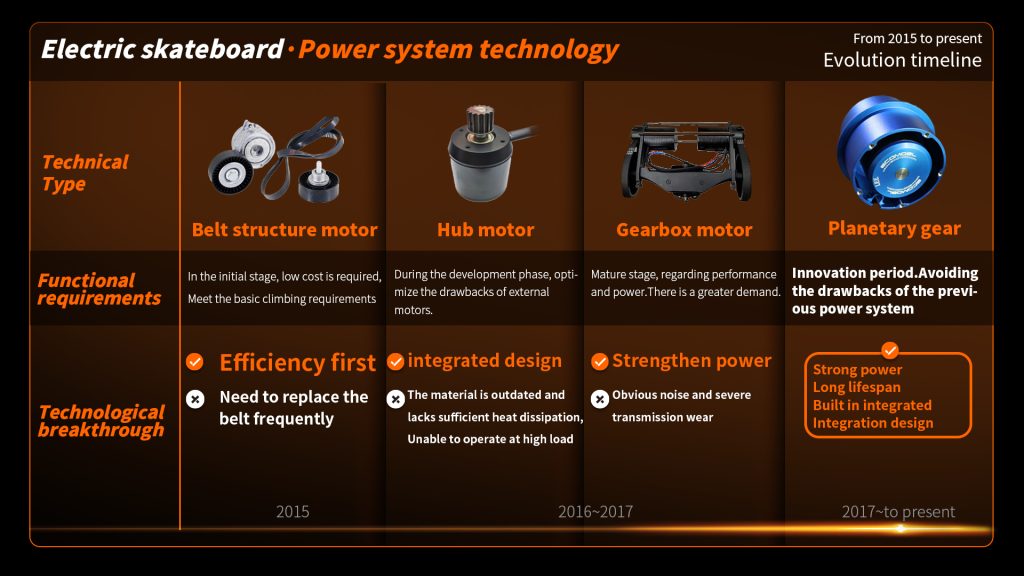
The motor is the heart of an electric skateboard. Traditional hub motors suffer from low torque, poor durability, and high power loss. Planetary gear motors solve these limitations and are now the preferred choice for mid to high-end boards.
Planetary Gear Motor vs Traditional Hub Motor – Practical Value Comparison
| Comparison Dimension | Planetary Gear Motor | Traditional Hub Motor | Practical User Value |
|---|---|---|---|
| Transmission Structure | Multi-gear ring surround meshing, power evenly distributed | Single gear direct drive, load concentrated on one point | Even force distribution reduces stress on components, lowers motor failure rate by 60%, and extends service life up to 3 times. No frequent repairs needed. Truly “buy once and use it long-term.” |
| Sealing Performance | Integrated sealed housing, waterproof and dustproof up to IPX7 | Open structure, easily exposed to water vapor and dust | Safe to ride in rain and muddy roads. No worry about water damage. Handles complex off-road conditions easily. Just wipe dry after riding, no need for disassembly or deep cleaning. |
| Power Efficiency | Transmission efficiency up to 97%–99% | Transmission efficiency is only 70%–80% | Minimal power loss. With the same battery capacity, you get a longer range. Less frequent charging for commuting and more confidence for long weekend rides. |
Structural Advantages: Stronger, Sealed, and Built for Long-Term Use
Planetary gear motors use a sun gear, multiple planetary gears, and an internal ring gear. This design distributes load evenly and integrates the motor directly into the hub.
Key advantages include:
-
Multi-tooth power transmission that reduces mechanical stress
-
Fully sealed integrated housing
-
High resistance to water, dust, and impact
-
Significantly lower failure rate
-
Minimal maintenance requirements
Compared to traditional hub motors, planetary systems extend service life by up to three times and reduce failure risk by more than 60 percent.
This is the difference between a hobby-grade toy and a professional mobility tool.
Performance Advantages: Torque, Control, and Efficiency
Planetary gear motors use a reduction ratio of approximately 3:1 to 5:1, multiplying torque while maintaining high efficiency.
A dual planetary motor setup producing 6100W can generate up to 120 N·m of torque. This allows effortless climbing on 30 to 40 percent slopes, even with heavy riders.
Key performance benefits include:
-
Instant throttle response with almost zero delay
-
Smooth acceleration without jerking
-
High-speed stability
-
Precise speed control in traffic
-
Strong regenerative braking
Transmission efficiency reaches 97 to 99 percent, compared to only 70 to 80 percent on traditional hub motors. This translates directly into longer range and better battery utilization.
Thermal Management and Reliability
The integrated structure improves heat dissipation by approximately 40 percent. Even during extended uphill riding, the motor remains within safe operating temperatures.
This prevents thermal degradation, power drop-off, and long-term damage. Riders avoid the common problem of motor overheating and permanent performance loss.
Multi-Scenario Adaptability
Planetary gear motors excel across all riding conditions. In urban environments, they deliver quiet operation under 65 dB, smooth starts, and efficient regenerative braking.
On off-road terrain, the high torque output easily handles gravel, mud, roots, and steep inclines. The IPX7 sealing standard allows riding in rain, snow, and wet conditions without concern.
In performance configurations, dual-drive and all-wheel-drive setups reach top speeds of 27 to 30 mph while maintaining stability even with rider weights up to 150 kg.
This makes planetary gear motor boards true all-terrain machines.
Read: How Do Electric Skateboards Actually Work? Everything You Need to Know
3. Supporting Specifications That Define Comfort and Safety

Once the motor is chosen correctly, four supporting systems determine real-world comfort and safety.
Battery and Real-World Range
Always evaluate the range under real load conditions. Marketing numbers often reflect ideal laboratory tests with light riders on flat roads.
Look for:
-
High-quality lithium cells
-
Integrated BMS protection
-
Real-world range testing under 65 kg or higher
-
Fast charging in 3 to 4 hours
Choose a range of at least 10 km beyond your daily needs to eliminate range anxiety.
Deck Construction and Suspension
A premium deck should use at least nine layers of Canadian maple combined with fiberglass reinforcement. This provides elasticity, impact resistance, and long-term structural integrity.
For commuting, front suspension is recommended. For off-road riding, independent suspension is essential for vibration filtering and foot fatigue reduction.
Braking System and Safety Equipment
Braking performance defines survival in emergencies. At 20 km/h, the dry braking distance should not exceed 4 meters. A dual braking system combining regenerative braking and physical disc braking offers the fastest response.
Front and rear lighting must be standard. Waterproof rating should be at least IPX4. Compliance with CE or GB/T standards ensures structural and electrical safety.
Tires and Stability
Deck width should range between 10 and 12 inches for optimal stance stability. Commuting tires should be 8 to 10 inches with smooth tread for grip and low noise.
Off-road tires should be 10 to 12 inches with deep tread and puncture resistance.
4. Real-World Comparison: The $800–$1000 Segment

At this price level, motor technology defines the experience.
| Category | Dual Planetary Motor Model | Traditional Hub Motor A | Traditional Hub Motor B |
|---|---|---|---|
| Power | 6100W total | 500W | 500W |
| Torque | 120 N·m | 35 N·m | 30 N·m |
| Climbing | 30–40% | 15° | 12° |
| Real Range | 40–50 km | 30 km | 20 km |
| Suspension | Independent | Front only | None |
Long-term user feedback consistently shows planetary motor boards retain full performance after two years, while traditional hub models often develop noise, power loss, and climbing weakness within six months.
5. Pitfall Avoidance Checklist
Avoid these five common traps:
-
Misleading specifications without real-world testing data
-
Ultra-cheap models using low-grade battery cells and weak braking systems
-
Poor deck construction without fiberglass reinforcement
-
Brands with no after-sales service or spare parts availability
-
Flashy features that add cost but not performance or safety
Final Recommendation
For men aged 30–45, the real value of an electric skateboard lies in control, reliability, and practical performance. These qualities are determined first and foremost by motor technology.
Planetary gear motors deliver superior torque, efficiency, durability, and adaptability. They transform electric skateboards from fragile toys into dependable transportation tools suitable for daily commuting, weekend exploration, and long-term ownership.
Choose the right motor, and everything else falls into place.
Save this guide, use it during your purchase decision, and share it with friends considering an upgrade. If you need a personalized recommendation based on your commute distance and typical road conditions, feel free to reach out.
Your ride deserves engineering, not marketing.

