


Finding Your Ideal Board Stance
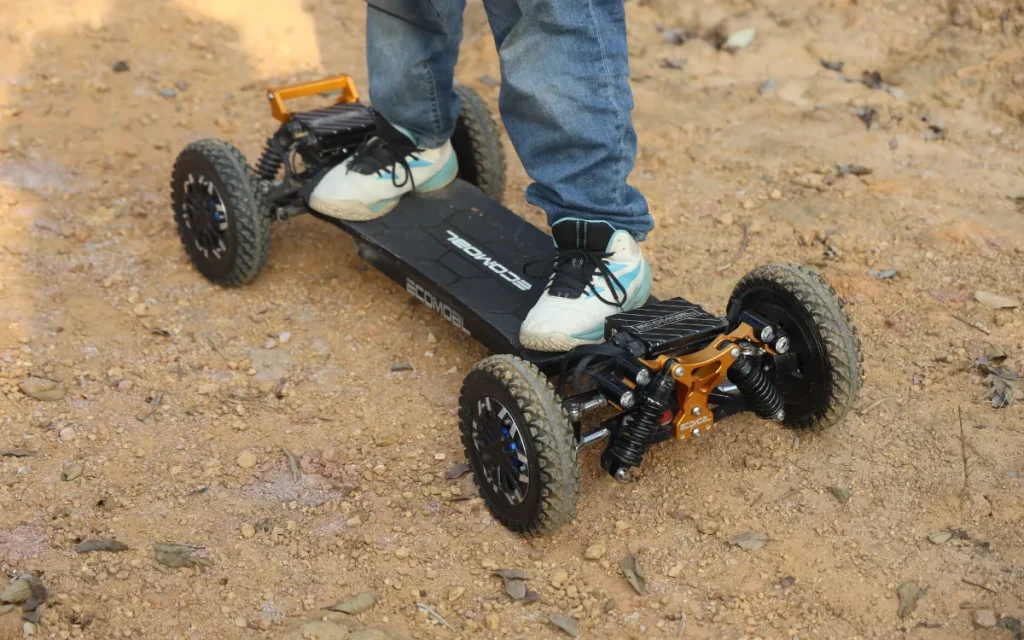
Mastering your stance and balance starts before you even touch the grip tape. You cannot guess your natural orientation.
The Push Test
- Stand relaxed on a flat floor with your eyes closed.
- Have a friend push you gently forward from between your shoulder blades.
- The foot you instinctively step forward with to catch yourself is your lead foot.
Left foot forward = Regular. Right foot forward = Goofy.
Knowing whether you ride a regular or goofy stance dictates your entire setup. Once you step onto the deck, your foot placement must be exactly shoulder-width apart. If you stand too narrow, a half-inch crack in the pavement shatters your stance and balance. Standing too wide can lock your hips and restrict movement and maneuverability.
Whether I was riding a regular or goofy stance, once I planted my feet shoulder-width apart, I stopped fighting the road. I wasn’t just balancing on the board anymore; my lower body was acting as a shock absorber, locking in my stance and balance naturally.
Dialing In Your Weight Distribution
The motor type under your deck changes how you manage sudden torque. Whether you are riding a hub-motor, belt-driven, or gear drive, you must actively shift your weight distribution to match the board’s acceleration curve.
Riding stiff-legged is a guaranteed trip to the asphalt. Keeping your knees bent is your most vital natural suspension system. When a belt-driven motor violently kicks in, a rigid body acts like a lever, snapping you backward. Once I started keeping my knees bent and driving my front shoulder down during take-off, the sudden jolt stopped throwing me off balance.
At high speeds, perfecting this forward weight distribution eliminates the speed wobbles that routinely throw unprepared beginners off the tail.
Read: How Do Electric Skateboards Actually Work? Everything You Need to Know
Executing Smooth Toeside and Heelside Turns
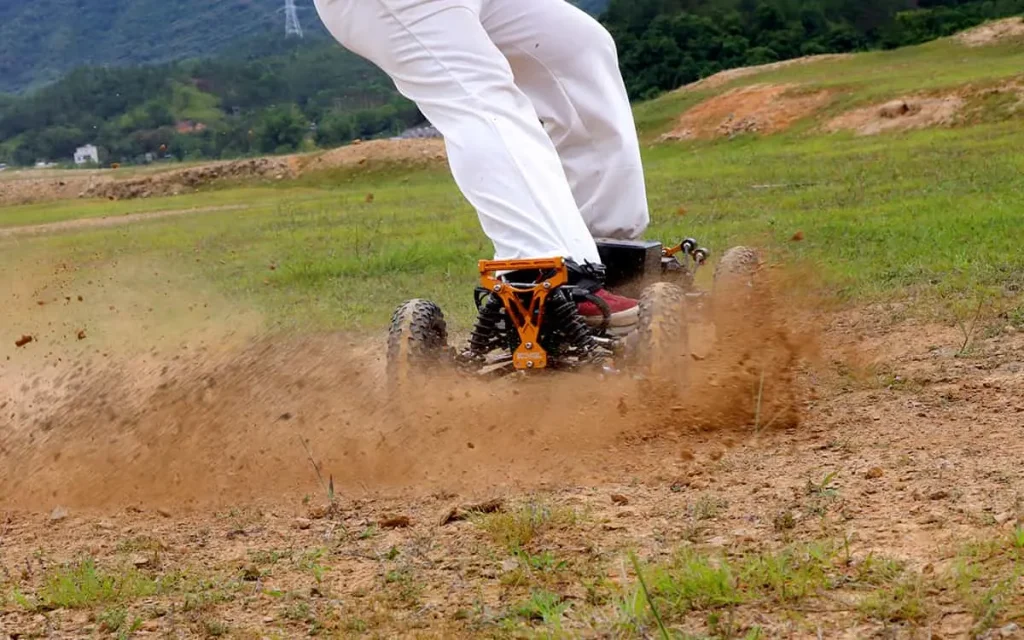
I spent weeks awkwardly ankle-tilting my board through turns until I finally took a skate tool to my board’s trucks, the metal, T-shaped axles connecting the wheels to the deck. Loosening the main center bolt (the kingpin) by just a half-turn changed everything. True carving on an electric skateboard is not steered with your feet; it is driven by leaning your hips and dropping your shoulders into the apex of the curve.
Practice Schedule
- Week 1: Wide, low-speed toeside arcs in an empty parking lot.
- Week 2: Linking heelside to toeside at 10 mph (focusing on shoulder rotation).
- Week 4: High-speed fluid carving using deep hip compression down a gentle slope, like the paved paths at Dolores Park.
Once I stopped trying to steer with my ankles, I could let my bodyweight push the wheels smoothly through the curve.
Mastering Acceleration, Braking, and Speed Control
My first heavy braking session nearly launched me onto concrete. E-skate torque demands immediate, physical respect.
Navigating the Remote Throttle and Brakes
My beginner error was aggressively flicking the thumbwheel, and the terrifying lurch nearly bucked me off the deck. I quickly realized that achieving smooth acceleration and deceleration requires fluidly and slowly rolling the thumbwheel.
Whenever I engage remote braking and regenerative brakes, I proactively shift my center of gravity. To accelerate smoothly, I press my front knee forward. Then, to gradually slow down, I intentionally lean back when braking, dropping my hips to counteract the intense forward momentum.
I learned about battery physics the hard way. There was a terrifying afternoon when I bombed a steep downhill right after unplugging my board from the charger. Because I had a fully charged battery, the Battery Management System (BMS) shut off the motors to prevent overcharging.
Suddenly, I had zero stopping power. I realized then that to brake properly on an electric skateboard, I couldn’t solely trust the electronics. I needed to learn how to manually and gradually slow down before a total system cutoff ended in disaster.
Conquering Speed Wobbles Safely
At twenty miles per hour, my deck began to oscillate violently. Pure panic set in. When researching speed wobbles and how to avoid them, I discovered the issue is rarely an immediate hardware failure; it is almost entirely about riding posture.
To visualize the fix, here is how I break down balancing technique versus gear adjustments:
| Focus Area | My Action Plan | Expected Impact |
|---|---|---|
| Posture (The Anchor) | Pinning 60% of my body weight strictly over the front truck (the metal T-shaped axles). | Forces the rear wheels to trail smoothly behind, instantly reducing oscillation. |
| Hardware (The Assist) | Tightening the rear trucks or swapping to harder rubber bushings. | Helps dampen road vibrations, but absolutely will not save a terrible riding stance. |
During that terrifying wobble, I learned that to brake properly on an electric skateboard under duress, I could never stiffen my legs. Instead, I drop my hips, shift my mass forward, and firmly ride out the vibration until I regain complete physical control of the deck.
Emergency Stops and Footbraking Basics
When the battery inevitably cuts out, footbraking becomes my only survival tool. To brake properly on an electric skateboard manually, I had to master the analog backup.
Instead of a clean, robotic checklist, my early footbraking practice was a messy trial-and-error process. First, I practiced shifting my weight entirely onto my front leg until my thigh burned. Then, I nervously lowered my back foot toward the pavement, making sure to drag the sole completely flat. I quickly found out that using just the toe or heel caused my shoe to violently skip and bounce across the asphalt.
As the friction built up under my shoe, I found I had to forcefully lean back when braking to prevent my dragging foot from pulling my upper body off the nose of the board. Practicing this scuff-and-drag method at low speeds translated into a genuine lifesaver at higher velocities. Trusting my plain shoe rubber today guarantees I can stop on my own terms tomorrow.
Also read: 10 Most Common Problems Electric Skateboard Riders Face
Essential Gear and Terrain Awareness for Safe Commuting
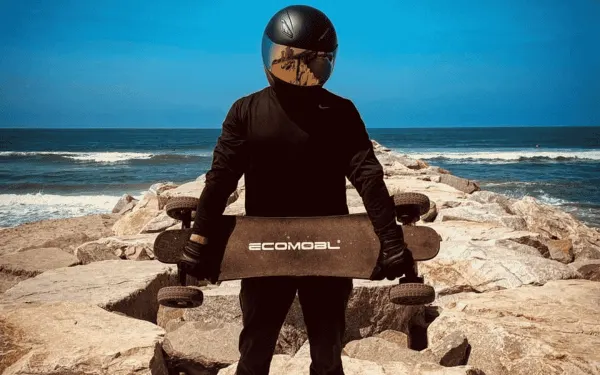
I once skipped my pre-ride check, hit a slick wet patch at fifteen miles an hour, and instantly ate raw asphalt.
Non-Negotiable Protective Gear
I don’t trust standard safety gear at electric speeds. I won’t step on my board without a CPSC-certified full-face helmet. However, it’s vital to know that basic US bicycle certification only tests for impacts at around 15 mph. At twenty miles per hour, a standard foam lid won’t save your jaw when a wheel locks up. To truly protect yourself at electric speeds, you need gear rated for the velocity you’re traveling:
| Standard | Designed For | Tested Speed Rating |
|---|---|---|
| CPSC | Standard Bicycles | Up to ~15 mph |
| NTA 8776 | E-Bikes & Speed Pedelecs | Up to 28 mph |
| ASTM F1952 | Downhill Mountain Biking | High-speed, multi-angle impacts |
But a helmet is only your baseline. During a nasty 20mph slide last year, my helmet saved my head, but I instinctively braced with my hands. Without dedicated safety gear, specifically heavy-duty wrist guards, I would have shattered both wrists instead of just scraping plastic. Protective equipment also extends to your footwear.
Ditch the running shoes. Flat, thick-soled skate shoes provide vital mechanical grip and dampen high-frequency road vibrations.
Reading Terrain and Avoiding Hazards
I learned quickly that surviving the streets means I have to understand terrain and road conditions before my urethane ever touches them. Scanning twenty feet ahead buys me the split-second I need to dodge shattered glass and rogue potholes.
Whenever I carve into a blind corner, I instinctively look ahead and scan for obstacles. At speed, your feet become your second set of eyes. Smooth pavement glides, while rough patches violently chatter through the deck.
When I feel that high-frequency vibration hitting my front foot, I immediately drop my center of gravity, bend my knees, and shift my weight over the back truck. That widened stance keeps me planted so I can avoid obstacles and debris without speed wobbles. Even with perfect form, your reaction time plummets on wet roads. I have one personal rule I never break: I do not ride in the rain. Polyurethane wheels instantly lose traction on wet asphalt, and the water will eventually short-circuit your electronics.
Visibility and Shared Space Etiquette
My worst early mistake wasn’t a physical crash. It was the time I silently blew past an elderly pedestrian from behind. She jumped and stumbled, and I was deeply embarrassed. Electric skateboards are startlingly quiet, and that awkward encounter completely changed how I ride.
Now, I explicitly call out “On your left!” well before passing anyone. In shared bike lanes, I match the speed of bicycle traffic rather than weaving unpredictably. I make sure to look ahead and scan for obstacles that might force a cyclist to swerve into my path, giving them plenty of room to safely avoid them. External visibility is another crucial form of safety gear.
Standard reflectors fail at night. Mount high-lumen, strobing lights directly to your deck, and attach a secondary red blinker to the back of your helmet. Never assume cars or pedestrians see you, make your presence absolutely impossible to ignore, and treat your visibility like the most important safety gear you own.
Related: 9 Common Myths About Electric Skateboards Debunked
Final Thoughts
Looking back, every mistake I made from fighting violent speed wobbles to nearly losing braking control came down to one simple truth: electric skateboarding punishes hesitation and rewards awareness. There is no shortcut to mastering it. The board only responds to what you physically commit to your stance, your balance, your weight distribution, and your decisions in the moment.
What changed everything for me was shifting my mindset. I stopped treating the board like a gadget and started treating it like an extension of my body. Once I trusted proper posture, kept my knees loose, and stayed deliberate with every movement, the chaos began to fade. The same roads that once felt unpredictable started to feel readable, even controlled.
But control doesn’t mean complacency. Every ride still demands respect for speed, for terrain, and for the limits of both the machine and myself. The difference now is that I ride with intention instead of reaction. I anticipate instead of panic.
If there’s one thing I’ve learned, it’s this: confidence on an electric skateboard isn’t built by going faster, it’s built by understanding how to stay stable when things go wrong. Master that, and the ride stops being something you survive… and starts becoming something you truly enjoy.

