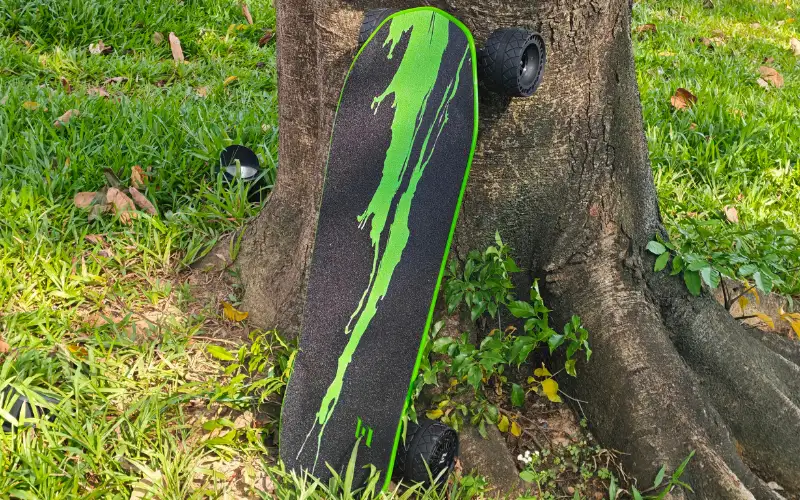


Yes, electric skateboards can go uphill. How well they climb depends on four things: motor torque, motor type, battery voltage, and how the weight of the rider is distributed across the wheels. A basic commuter board might struggle on anything steeper than a gentle slope, while a purpose-built off-road electric skateboard can climb grades that would stop a regular board dead in its tracks.
New riders often ask this question before their first purchase, and it is a fair one. Not every board is built the same, and the difference between a board that struggles on a hill and one that powers through it comes down to engineering choices you can actually check before you buy. This guide breaks down exactly what makes a board climb well and what to look for on the specs sheet before you decide.
The Short Answer
Electric skateboards can go uphill, but performance varies widely between models. The key factors are motor torque, motor type, battery voltage and capacity, wheel and tire type, and how many wheels are powered. Boards with higher torque output, planetary gear or belt-driven motors, higher voltage batteries, and four powered wheels instead of two climb steeper grades with less strain on the components.
The Science Behind Uphill Riding
When you ride uphill, your electric skateboard has to work against gravity. That resistance is overcome by torque, the twisting force that turns the wheels, and it matters more here than the top speed number most riders check first. The more torque a board produces, the easier it climbs, and the less the motor has to strain to keep moving.
Every board also carries a hill grade rating, which shows the steepest slope it can climb under normal conditions. Here is how that typically breaks down:
| Board Type | Hill Grade Rating | Typical Terrain |
| Basic commuter boards | 10% to 15% | Gentle hills, flat streets |
| Dual-motor boards | 20% to 25% | Moderate slopes, mixed terrain |
| High-performance or 4WD boards | 30% to 40% | Steep hills, off-road trails |
In short, if hills are part of your regular route, look for a board with higher torque output and a drivetrain built to handle sustained climbing rather than short bursts of speed.
Read: Best Electric Skateboards for Hilly Areas (Top 4 Picks)
Motor Power and Motor Type Make the Difference
The type of motor under your deck plays a bigger role in hill performance than most riders expect. There are three common types found on electric skateboards today:
- Hub Motors: Quiet and low maintenance, but they generally offer less torque. They perform best on flat roads and mild slopes.
- Belt-Driven Motors: Use belts and pulleys to deliver stronger torque, which makes them well suited to steep or uneven terrain, though the tradeoffs against a direct drive setup are worth knowing before you commit to one or the other.
- Planetary Gear Motors: A hybrid design that combines the quiet operation of hub motors with the torque output of belt systems.
The Planetary Gear Motor Advantage
Inside every planetary gear motor are small internal gears that multiply torque output before it ever reaches the wheel. In practice, that means:
- Strong climbing power without giving up top speed
- Smooth acceleration on steep hills instead of a jerky power delivery
- Better energy efficiency, which reduces strain on the battery
- Improved traction and control on both paved roads and off-road trails
This is why boards built around this motor type can tackle hills and mountain trails that leave many standard skateboards stuck halfway up.
Battery Power and Voltage
Even the strongest motor is only as good as the power feeding it. Higher voltage batteries deliver more current to the motors, allowing them to produce stronger torque. A 12S battery (44.4V) will climb noticeably better than a 6S battery (22.2V), even with a similar motor.
High-quality lithium battery packs maintain a consistent power flow and help prevent voltage sag, a problem that usually traces back to poor charging and storage habits rather than a fault in the pack itself.
Weight, Load Capacity, and Drive Type
The heavier the rider, the harder the motors have to work to maintain speed on an incline. That is why weight and power output should always be considered together.
For heavier riders, or anyone who regularly rides steep or mixed terrain, dual and four-wheel-drive boards are usually the better choice. Distributing torque across four wheels instead of two, the core difference between a 2WD and 4WD setup, makes hill climbs smoother, reduces wheel spin, and keeps the board more stable on loose surfaces. The Telum BA and M24 Pro both lean on this kind of setup for exactly that reason.
Wheel Type and Traction
Wheel design has a real impact on how a board handles an incline, especially once the surface stops being smooth pavement.
- Urethane wheels: Fast and smooth on flat roads, but they can lose grip on steep or uneven ground.
- Pneumatic or rubber wheels: Offer strong traction and shock absorption, which makes them a better fit for climbing hills or riding off-road.
Large rubber tires designed to grip the surface and resist wheel spin are standard on all-terrain boards, which is part of why they hold a line better on gravel, grass, or dirt hills than a street-focused board with hard urethane wheels.
The Role of the ESC (Electronic Speed Controller)
The electronic speed controller manages how power moves from the battery to the motor, and a well-tuned one is the difference between smooth, controlled acceleration on a hill and a jerky, unpredictable power surge. A strong motor paired with a poorly tuned ESC will still feel rough on a climb, which is why the two are engineered together rather than treated as separate parts.
Real World Comparison
Picture two riders approaching the same hill. One is on a standard city board with hub motors. It handles flat ground fine, but the moment the road tilts upward, the power drops off, and the throttle can’t compensate. The other rider is on a planetary gear motor board. As soon as the incline starts, torque kicks in smoothly, and the board holds its speed and balance all the way to the top.
That difference is not about branding. It comes down to torque output, motor type, and how well the whole power system, motor, battery, and ESC, is matched together.
Tips for Riding Uphill Smoothly
A powerful board still needs good technique behind it. These habits make climbing safer and more efficient:
- Lean slightly forward to maintain balance and traction.
- Use consistent, gradual throttle input instead of sudden bursts of power.
- Build momentum before the climb rather than starting from a full stop.
- Choose the speed mode that favors torque over top speed on steep sections.
- Keep your weight balanced and your knees slightly bent.
Most climbing problems trace back to throttle habits rather than a lack of power, which is one of the more common mistakes new riders make before they get a feel for how their board responds on an incline.
Safety First
Climbing hills demands more power and more control, so a few precautions matter here more than on flat ground.
- Check the terrain ahead for loose gravel or wet patches before committing to a climb.
- Wear protective gear, especially a helmet and wrist guards, every time you ride.
- Test your brakes before heading downhill. Braking control matters as much as climbing power.
- If your board has regenerative braking, use it gently on descents to maintain control and recover some charge.
Off-road boards are generally designed with these climbs in mind, from tire choice down to how the suspension reacts to a sudden change in grade, though no amount of engineering replaces basic caution and the right gear.
Two Boards Built for Uphill Climbing
These two models are engineered specifically to handle steep inclines and rough terrain.
1. Ecomobl Hybrid X5 4WD
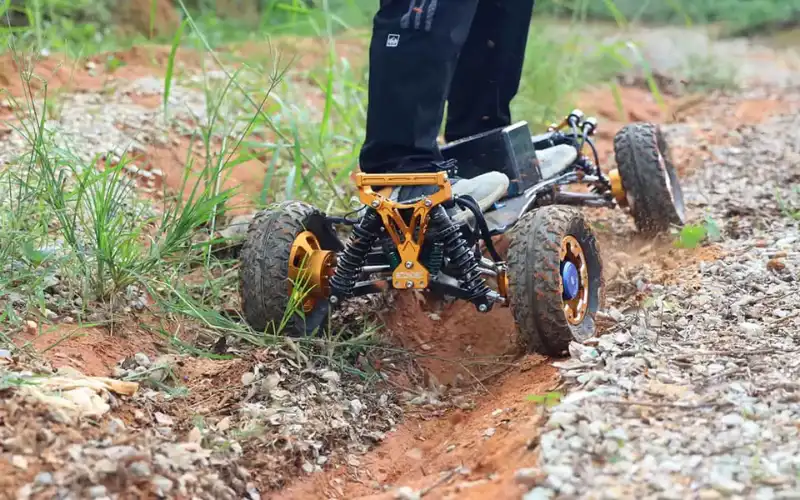
- Max speed: 55 to 65 km/h (34 to 40 mph)
- Range: 40 to 55 km (25 to 34 miles) for a rider around 65 kg
- Battery: Samsung 40T cells in a 14S6P configuration, roughly 1,209.6 Wh
- Wheels: Pneumatic tires (250 mm x 76 mm) for off-road traction
- Deck: 100% carbon fiber flexi deck built for rough terrain
- Extras: Integrated headlight and taillight, removable battery case, planetary gear motors for high torque on steep terrain
The Hybrid X5’s high-spec drivetrain and large battery are built for steep slopes rather than gentle inclines. Large pneumatic wheels and a carbon fiber deck add stability on rough or hilly terrain, which makes it a strong option for riders who regularly face hilly or mixed off-road routes.
2. Ecomobl M24 Pro 4WD
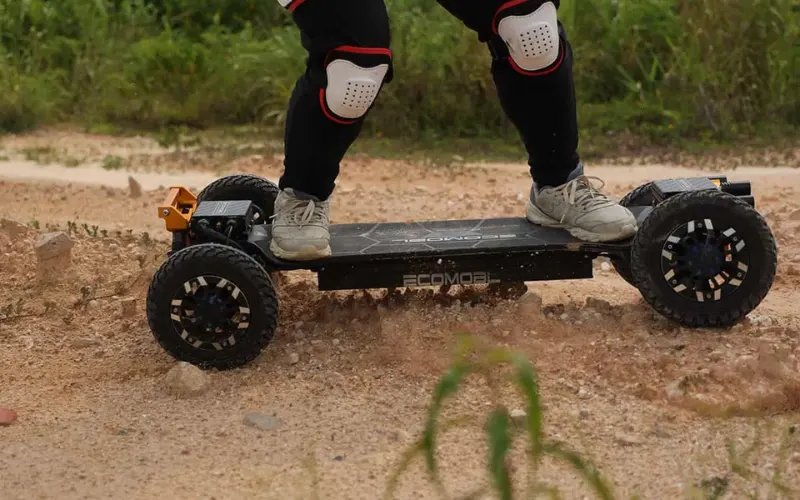
- Max speed: approximately 45 to 50 km/h (27 to 30 mph)
- Range: about 40 to 50 km (25 to 30 miles) under ideal conditions
- Battery: roughly 960 Wh (12S5P Samsung 40T in one spec configuration)
- Tires and build: 10-inch knobby tires with a robust suspension system for off-road terrain
- Extras: Independent suspension per wheel, headlight and taillight, IP56 rating on some builds for dust and water resistance
While its top speed is a little lower, the M24 Pro shines in torque and climbing ability thanks to its 4WD planetary gear drive and off-road tires. Its suspension system helps maintain traction and control on varied terrain, which makes it well suited to routes that include steep hills, grass, gravel, or trails.
Final Thoughts
So, can electric skateboards go uphill? Yes, and the ability to climb well comes down to motor torque, battery voltage, drive configuration, and overall build quality rather than marketing claims about top speed.
Boards built around planetary gear motors, higher-voltage batteries, and 4WD drivetrains, like the Hybrid X5 and M24 Pro, are engineered specifically to handle steep hills and rugged terrain without losing power halfway up. Matching torque and drivetrain to your terrain matters far more than chasing a bigger top speed number on the spec sheet.