

Open any electric skateboard spec sheet or rider forum, and you will quickly run into a wall of jargon. ESC, kV, 10S2P, wheel bite, drop-through, regen. If you are new to the sport, it can feel like a different language.
This glossary explains the most common electric skateboard terms in plain English. The terms are grouped by topic, so you can read straight through or jump to the section you need. Use it while comparing boards, reading reviews, or troubleshooting a problem on your own setup.
Board Basics
Esk8: Short for electric skateboard. The term is widely used by riders and builders online, and it shows up in community groups, forums, and social media hashtags. If you want to meet other riders, our guide to building an electric skateboard community is a good place to start.
Longboard: A skateboard with a longer deck than a standard trick skateboard, built for cruising and stability. Many electric skateboards use longboard-style decks.
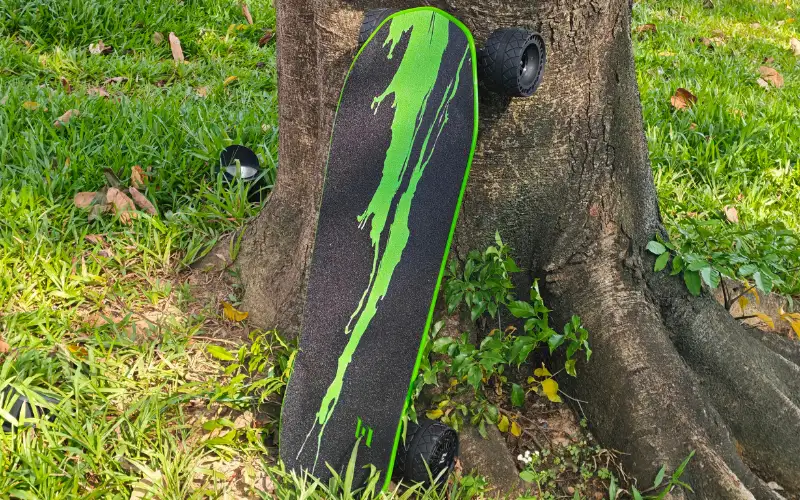
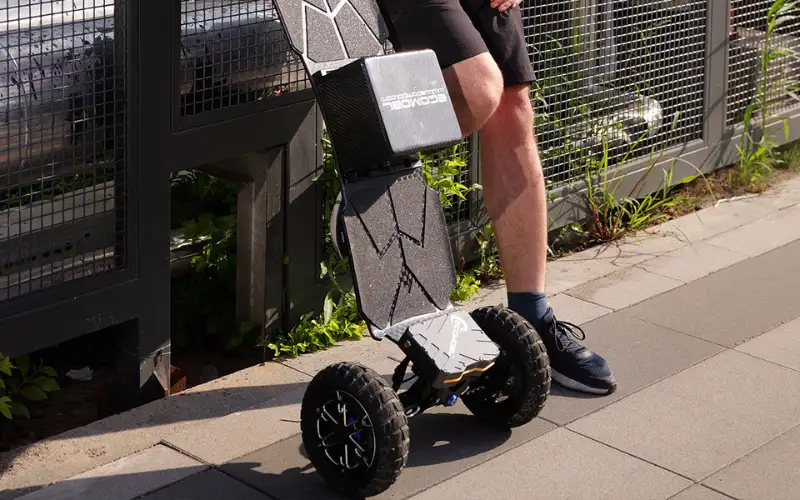
Mountain board (all-terrain board): An electric board built with larger wheels and a sturdier frame for dirt paths, grass, and rougher surfaces. If you are curious about where these boards can safely go, read our breakdown of what terrains electric skateboards can handle.
Deck: The flat platform you stand on. Decks are commonly made from maple, bamboo, fiberglass, carbon fiber, or a mix of materials, and they usually house the battery and electronics underneath.
Nose: The front end of the deck, in the direction you are traveling.
Tail: The rear end of the deck. On many boards, the tail is also where riders shift their weight to turn or brake.
Kicktail: An upturned section at the rear (or front) of the deck. It lets you pivot the board, lift the front wheels over small obstacles, and make tight turns at low speed.
Concave: The side-to-side curve of the deck. More concave gives your feet more grip and control. Less concave feels flatter and more relaxed.
Flex: How much the deck bends under your weight. A flexible deck absorbs vibration and feels smoother over rough pavement, while a stiff deck feels more stable and responsive at high speed.
Wheelbase: The distance between the front and rear trucks. A longer wheelbase is generally more stable at speed, and a shorter one feels more nimble in tight turns.
Top-mount: A deck design where the deck sits on top of the trucks. It gives a higher ride and more leaning ability, which many riders like for carving.
Drop-through: A deck design where the trucks pass through cutouts in the deck, so the board sits lower to the ground. Lower decks are easier to push and feel more stable for commuting.
Grip tape: The sandpaper-like surface applied to the top of the deck to keep your feet from slipping.
Regular and goofy: Your riding stance. Regular means left foot forward, goofy means right foot forward. Neither is better, and most riders have a natural preference.
Trucks and Suspension
Trucks: The metal T-shaped assemblies that attach the wheels to the deck and allow the board to turn when you lean.
Hanger: The wide, triangular part of the truck that holds the axle. It pivots as you lean.
Kingpin: The bolt that runs through the center of the truck and holds the bushings in place. Tightening or loosening it changes how easily the board turns.
Bushings: Rubber or urethane cushions inside the truck. Softer bushings make the board turn more easily, while harder ones feel more stable at speed. Bushings are rated by durometer.
Baseplate: The part of the truck that bolts to the deck.
Axle: The rod that runs through the hanger and holds the wheels in place.
Riser pads: Small spacers placed between the truck and the deck. They add clearance for larger wheels and help prevent wheel bite.
Suspension: A system of springs or dampers that absorbs impacts, usually found on all-terrain boards. It improves comfort and keeps the wheels in contact with uneven ground.
Wheels and Tires
Durometer: A measure of how hard a wheel or bushing is, usually shown with an “A” after the number (such as 78A). Lower numbers are softer and grippier, and higher numbers are harder and faster.
Urethane: The material most skateboard wheels are made from. It balances grip, durability, and roll speed.
Pneumatic tires: Air-filled rubber tires, similar to bicycle tires. They absorb bumps and grip well on rough or loose surfaces, but they can go flat and require pressure checks.
Airless tires: Solid or foam-filled tires that never go flat. They need less maintenance, though they can feel firmer over rough ground.
Bearings: Small metal rings with ball bearings inside that let the wheels spin freely on the axle. Clean, lubricated bearings roll faster and last longer.
Wheel bite: When the wheel touches the underside of the deck during a hard turn, causing the board to stop suddenly or throw the rider. It is often prevented with riser pads, smaller wheels, or looser trucks.
Contact patch: The area of the wheel or tire that touches the ground. A larger contact patch generally means more grip.
Motors and Drive Systems
Brushless motor: The type of motor used in nearly all modern electric skateboards. It is efficient, durable, and requires little maintenance.
Hub motor: A motor built directly inside the wheel. Hub motors are quiet, have no belts to maintain, and are very common in commuter boards.
Belt drive: A system where a motor mounted on the truck turns the wheel through a belt. Belt drives tend to offer strong torque and easy gear changes, but the belts wear over time and need occasional replacement.
Gear drive: A drive system that uses gears to transfer power from the motor to the wheel. Gear drives offer strong torque and a sealed design that resists dirt and water.
Direct drive: A motor that turns the wheel with no belt or gear in between. Direct drive systems are simple, quiet, and low maintenance.
Dual motor: A board with two motors, usually one per rear wheel. Dual motors deliver more power, better hill climbing, and a bit of redundancy if one motor has an issue.
4WD (four-wheel drive): A board with motors driving all four wheels. It offers strong traction and power, especially on loose or steep terrain.
Torque: The twisting force a motor produces, usually measured in newton meters (Nm). Higher torque means stronger acceleration and better hill climbing.
kV rating: The number of revolutions per minute a motor spins per volt applied, with no load. A lower kV motor generally produces more torque, and a higher kV motor spins faster.
Sensored and sensorless motors: Sensored motors use small sensors to track rotor position, which gives smoother starts and better low-speed control. Sensorless motors are simpler but can feel rougher at very low speeds.
Cogging: A jerky, stuttering feel that can happen at very low speeds, especially with sensorless motors.
Electronics and Controls
ESC (electronic speed controller): The board’s electronic brain. It takes your input from the remote and tells the motor how much power to deliver, and it also manages braking.
VESC: An open-source speed controller design widely used in electric skateboards. Its popularity comes from fine-tuning options for acceleration, braking, and safety limits.
Remote controller: The handheld device that sends throttle and brake commands to the board. Remotes typically use a trigger, a wheel, or a thumb control.
Receiver: The small electronic unit inside the board that receives signals from the remote and passes them to the ESC.
Remote disconnect (dropout): A temporary loss of connection between the remote and the board. It can cause sudden power loss or unexpected braking, so it is worth understanding before you ride in busy areas.
Firmware: The software that runs on the ESC and remote. Firmware updates can adjust acceleration, braking behavior, and safety features.
Companion app: A smartphone app that lets you adjust ride settings, check battery level, and monitor performance.
Riding modes: Preset profiles that adjust acceleration, braking strength, and top speed. A beginner mode, for example, softens power delivery so the board feels more predictable.
Throttle response (acceleration curve): How quickly and smoothly power is delivered when you press the throttle. A gentle curve feels forgiving, and an aggressive one feels sharp.
Regenerative braking (regen): A braking method where the motor acts as a generator, slowing the board while sending a small amount of energy back to the battery. Understanding how it feels is a big part of riding safely, and our guide to electric skateboard braking techniques goes into detail.
Thermal throttling: An automatic reduction in power when the motor or controller gets too hot. It protects the electronics, but it can make the board feel weaker on long climbs or hot days.
Lighting kit: A headlight and taillight set that improves visibility in low light. If you ride in the evening, our picks for electric skateboards built for night riding cover what to look for.
Battery and Range
Battery pack: The collection of cells, wiring, and protection circuitry that stores the energy powering your board.
Cell: A single battery unit inside the pack. Electric skateboard packs commonly use cylindrical lithium-ion cells.
Lithium-ion (Li-ion): The most common battery chemistry in electric skateboards. It offers high energy density and a long cycle life when cared for properly.
Series and parallel (such as 10S2P): A way of describing how cells are wired together. The number before the “S” is how many cells are in series, which sets the voltage. The number before the “P” is how many are in parallel, which sets the capacity. A 10S2P pack has 20 cells in total.
Voltage (V): The electrical pressure of the battery. A 10S pack runs at around 36 volts, and a 12S pack at around 43 volts. Higher voltage generally supports higher top speeds and stronger power delivery.
Amp-hour (Ah): A measure of how much charge the battery holds. Higher amp-hours mean more capacity.
Watt-hour (Wh): The best single measure of battery capacity, found by multiplying volts by amp-hours. A larger Wh number generally means longer range.
BMS (battery management system): The circuit board that protects the battery from overcharging, over-discharging, overheating, and short circuits. It also keeps the cells balanced.
Range: How far the board can travel on one charge. Manufacturer range is usually measured under ideal conditions, and real-world range depends on rider weight, terrain, speed, and temperature.
Charge cycle: One full discharge and recharge of the battery. Batteries slowly lose capacity as cycles add up.
Voltage sag: A temporary drop in battery voltage under heavy load, such as hard acceleration or steep climbs. It is more noticeable when the battery is low.
Low-voltage cutoff: A safety feature that reduces or cuts power when the battery gets too low to protect the cells. It can cause the board to slow down quickly, so it is smart to leave a range buffer.
Swappable battery: A battery pack you can remove and replace with a charged one, which extends your total riding distance.
IP rating: A code, such as IP65, that shows how well a board’s electronics are protected against dust and water. The first digit relates to dust protection and the second to water protection.
Riding Terms
Cruising: Relaxed riding at a steady pace, usually for commuting or leisure. For practical commute advice, see our tips for riding in the city.
Carving: Making smooth, wide turns by leaning side to side, similar to snowboarding or surfing.
Freeride: A riding style that mixes carving, controlled slides, and technical maneuvers, often on open roads or smooth lots.
Downhill: Riding down steep slopes. It demands strong braking, good technique, and proper protective gear.
Speed wobbles: A fast, side-to-side oscillation of the board that can build quickly at higher speeds. It is frightening for new riders, but it is usually preventable. Our guide on how to prevent speed wobbles explains the causes and fixes.
Bail: Intentionally stepping off or jumping from the board to avoid a fall or collision.
Coasting: Rolling without applying throttle. Some boards allow free coasting, and others apply light motor drag.
Hill grade: The steepness of a slope, shown as a percentage. A 10 percent grade means the road rises 10 feet for every 100 feet traveled. Boards are often rated by the maximum grade they can climb.
PEV (personal electric vehicle): A broad category that includes electric skateboards, scooters, e-bikes, and similar small electric transportation. Local laws often classify boards under this term, so it is worth reading our overview of electric skateboard laws by state.
Last mile: The final stretch of a trip between a transit stop and your destination. Electric skateboards are a popular way to cover it, a topic we explore in our article on smart city mobility.
Keep Learning
New terms are easier to remember once you see them in real riding situations. If you are just starting, our guide on common mistakes new electric skateboarders make is a good companion to this glossary, and you can browse more guides in the Ecomobl blog.