


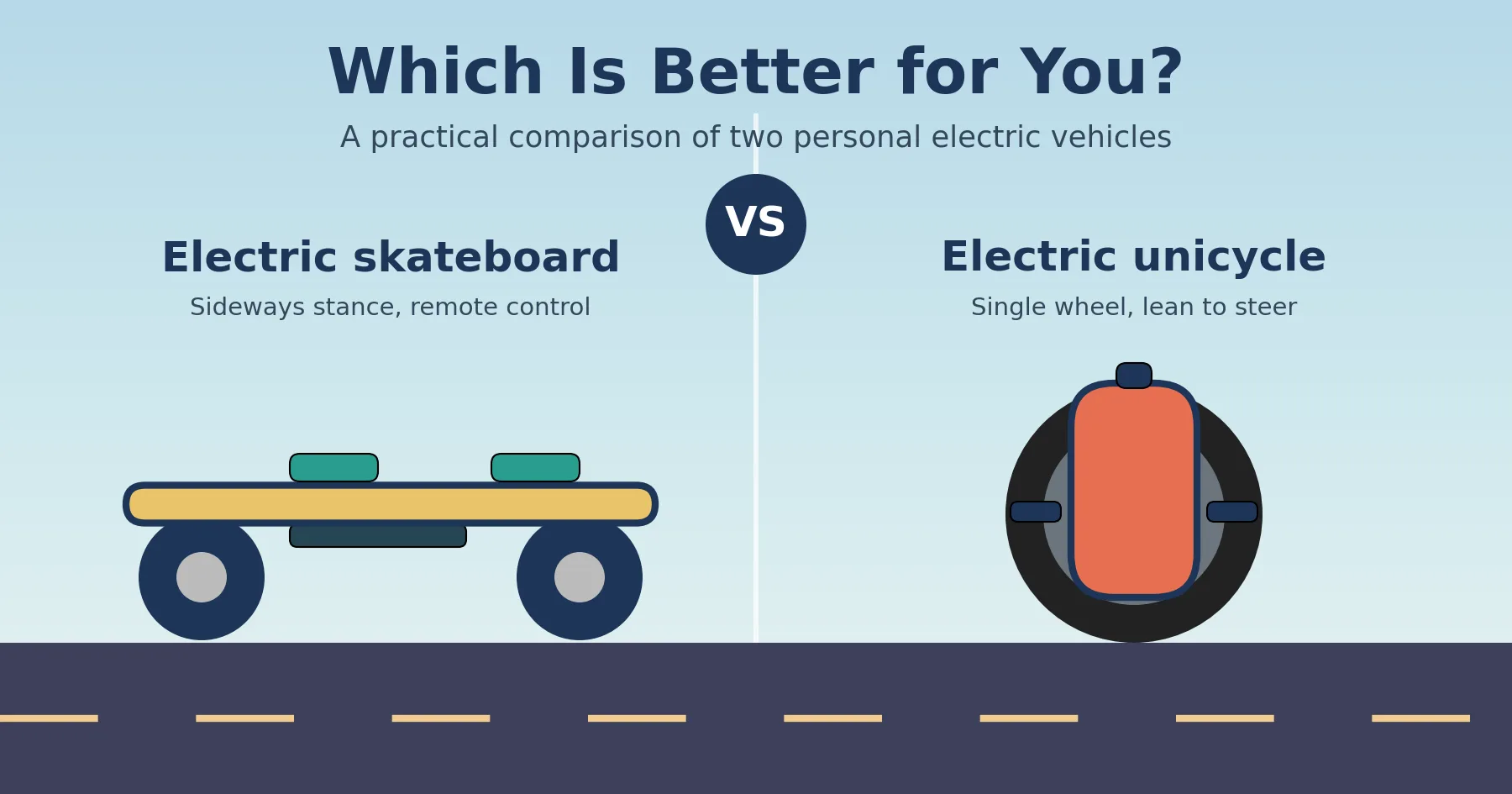
Electric skateboards and electric unicycles (EUCs) both promise the same thing: a small, fast, rechargeable way to cover short distances without a car. Beyond that, they could hardly feel more different. One gives you a flat deck and a handheld remote. The other asks you to balance on a single wheel and steer with your body.
If you are choosing between them, the right answer depends less on specs and more on how you plan to ride. This guide compares the two on the things that actually matter, using published manufacturer figures and official sources so you can judge for yourself.
The Short Answer
- Choose an electric skateboard if you already skate, snowboard, or surf, want a stable platform you can step off easily, or plan to ride trails and steep hills on an all-terrain board.
- Choose an electric unicycle if you want the most compact ride possible, do not mind a longer learning period, and like the idea of a hands-free, remote-free setup.
- Not sure? Think about the worst part of your daily route (stairs, hills, rough ground, crowded trains), then pick the machine that handles that part best.
How Each One Works
An electric skateboard is a deck with trucks, wheels, a battery, and one or more motors. You stand sideways, as on a regular skateboard, and control acceleration and braking with a wireless remote. If you want the mechanics in detail, our explanation of how electric skateboards work covers the motor, controller, and battery.
An electric unicycle is a single powered wheel with a pedal on each side. Built-in sensors detect your lean, and the wheel balances itself to match. Lean forward, and it speeds up; lean back, and it slows down. There is no remote and nothing to hold, which is a big part of its appeal. It also means you cannot simply stop pushing and coast like you can on a board, because the wheel needs power to stay upright.
Side-by-Side Comparison
Learning Curve
This is the biggest practical difference, and it is where an honest comparison matters most.
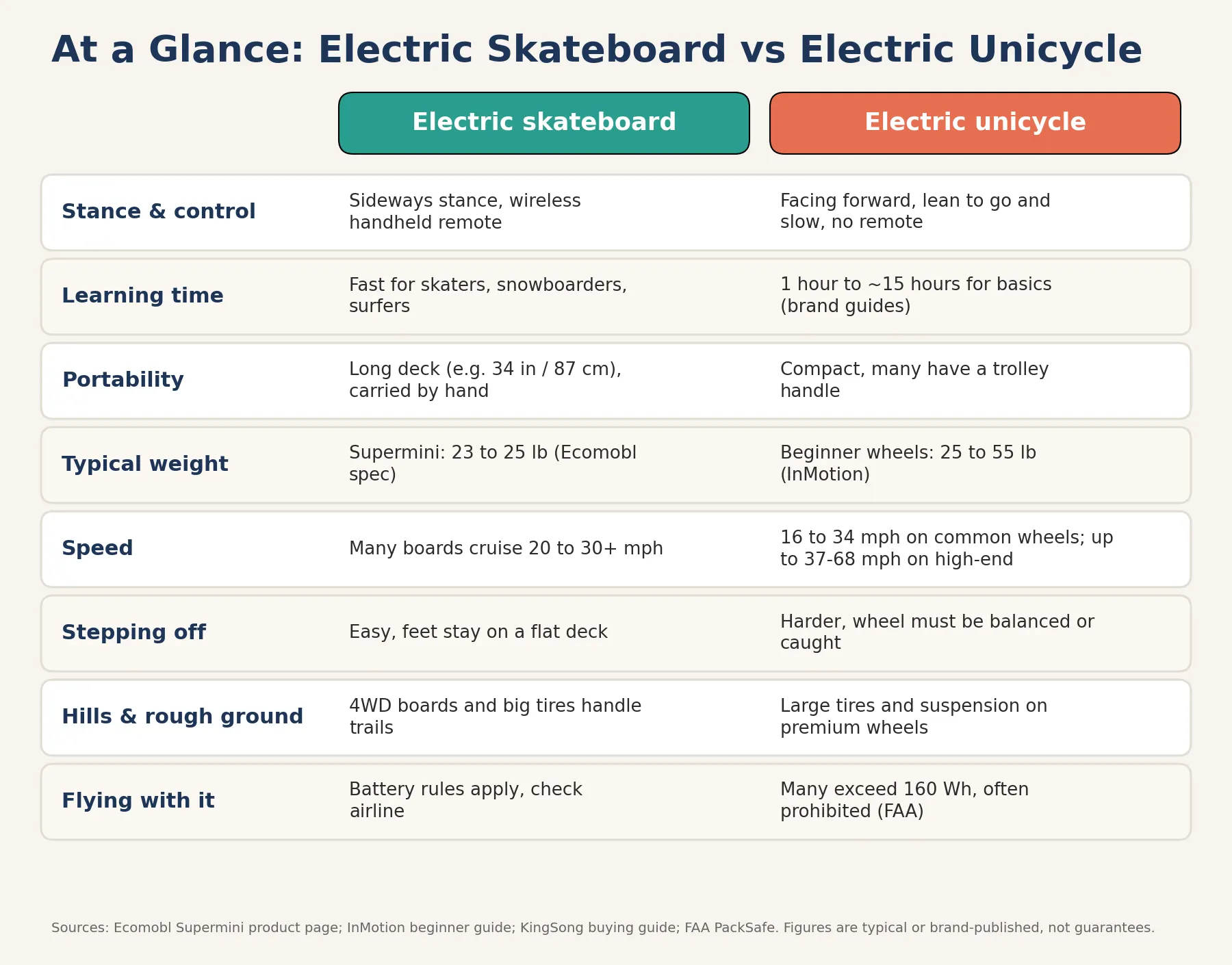
Electric unicycle manufacturers acknowledge a real learning period. InMotion’s beginner guide puts it at roughly 5 to 15 hours, while KingSong’s buying guide says most new riders need anywhere from an hour to several hours to gain basic proficiency. Most of that time is spent learning to mount, balance, and start without falling.
Electric skateboards usually feel familiar faster, especially if you have any background in skateboarding, snowboarding, or surfing, because the stance and weight shifts are similar. Total beginners still need practice with throttle and braking control, and our look at how long it takes to master an electric longboard sets realistic expectations.
The main difference is that a skateboard gives you a stable platform from the first minute, so early mistakes tend to be smaller ones. For a smooth start, our riding tips for new riders and the common mistakes new electric skateboarders make are worth reviewing before your first session.
Speed and Range
Both categories span a wide range, so compare specific models rather than categories.
For unicycles, InMotion’s guide lists its starter wheel at about 16 mph and 15 miles of range, a mid-size commuter wheel at about 22 mph and 25 miles, and its large suspension model at about 34 mph and 45 miles. At the high end, KingSong notes that performance wheels can reach 60 to 110 km/h (37 to 68 mph) on private roads or tracks.
For electric skateboards, many models reach 20 to 30 mph out of the box. As a concrete example, our Supermini street board lists up to 60 km/h (about 37 mph) and up to 63 km (about 39 miles) of range on the hub-motor version, with a charge time of 2.5 hours. Long-range boards go further still, as covered in our roundup of long-range electric skateboards.
One caution applies to both. InMotion advises that real-world unicycle range is typically 60 to 70 percent of the claimed figure, and the same discipline is wise for any “up to” range number on a board. Rider weight, hills, wind, temperature, and speed all cut into it.
Portability and Weight
Here the unicycle has a genuine edge in footprint. It has no long deck to carry, and many models include a retractable trolley handle so you can roll them like luggage. That makes them convenient for mixed commutes with stairs, trains, or office lifts.
They are not light, though. InMotion lists beginner wheels at 25 to 55 pounds. By comparison, the Supermini weighs 10.6 kg (about 23 pounds) in the hub-motor version and 11.2 kg (about 25 pounds) with gearbox motors, and measures 87 cm (about 34 inches) long. A skateboard is lighter than many unicycles but awkward to carry because of its length.
Neither is something you want to haul far, so for city riders the practical question is whether your route involves stairs and crowded spaces. Our tips for riding through the city cover how riders handle those situations on a board.
Control, Stopping, and Falling
Unicycles and skateboards fail differently, and this is worth understanding before you buy.
On a skateboard, if you lose balance or the board slows suddenly, you can step off. Your feet stay on a flat, low deck, and if the power cuts out, the board keeps rolling, and you can coast to a stop. Braking is done by the motors, and understanding regenerative braking helps you anticipate how the board slows.
On a unicycle, the wheel actively balances you, so the system depends on having power and not being pushed beyond its limits. Modern wheels use tilt-back warnings and speed alerts to tell riders when they are approaching those limits.
Retailers who sell them report that most cut-outs trace back to riders ignoring warnings or overloading the motor, which is why experienced riders treat those alerts seriously. In short, a unicycle rewards good habits and punishes lapses more sharply, while a skateboard is more forgiving of beginner errors.
Hills, Terrain, and Rough Ground
Terrain is where electric skateboards can be built for specialized jobs. All-terrain and mountain boards use large pneumatic tires, strong torque, and in some cases all-wheel drive to handle dirt, gravel, and steep climbs. If trails or hills are part of your plan, see our guides on boards for hilly areas, the difference between 4WD and 2WD setups, and which terrains electric skateboards can handle safely. Our all-terrain series and electric mountain boards are built around exactly these conditions.
Unicycles can handle rougher surfaces on premium models with larger tires and suspension, but they demand more skill on loose ground because every bump goes through your legs and balance. For most riders, a skateboard is the easier way to cover mixed terrain.
Safety and Protective Gear
We could not find reliable head-to-head injury data comparing electric skateboards and unicycles, so be wary of anyone claiming one is inherently safer. Safety depends mostly on speed, skill, surface, and gear.
What riders and manufacturers of both machines agree on is protective equipment. A helmet and wrist guards are the baseline for either, and knee pads, elbow pads, and gloves are strongly advised while you are learning. Review our safety precautions before your first ride, and if you want to understand what a fall can mean for recovery, our overview of injury recovery and rehabilitation is a sobering and useful read.
Cost and Maintenance
Prices overlap heavily. Electric skateboards typically cost between $600 and $3,000, with budget models under $300 and premium ones reaching $5,000, as laid out in our pricing guide. Unicycles run from a few hundred dollars for entry models to several thousand for high-performance wheels.
Maintenance differs in character. A board has more replaceable wear parts, such as wheels, bearings, bushings, and grip tape, so keeping up with a maintenance routine and knowing when to replace wheels pays off. A unicycle has a single tire and fewer external parts but a more complex internal system that is harder to service yourself.
For both, battery care is the biggest factor in long-term value, and you can browse spare and upgrade parts in our accessories section.
Laws and Travel
Rules for both vary by location, and neither is treated the same way everywhere. In the United States, regulations differ by state and city, which we break down in our guide to electric skateboard laws. Elsewhere, the rules can be stricter. In the UK, for example, government guidance classifies powered unicycles as “powered transporters,” which are treated as motor vehicles and cannot be used on public roads or pavements without meeting vehicle requirements. Always check your local rules before you buy.
Air travel is a hurdle for both. The FAA’s PackSafe guidance requires airline approval for lithium-ion batteries above 100 Wh and prohibits devices above 160 Wh in carry-on or checked baggage. The FAA notes that most unicycle-style scooters exceed 160 Wh and are therefore prohibited, and many electric skateboard batteries exceed the limits too. See our walkthrough of flying with an electric skateboard for the details.
Which Should You Choose?
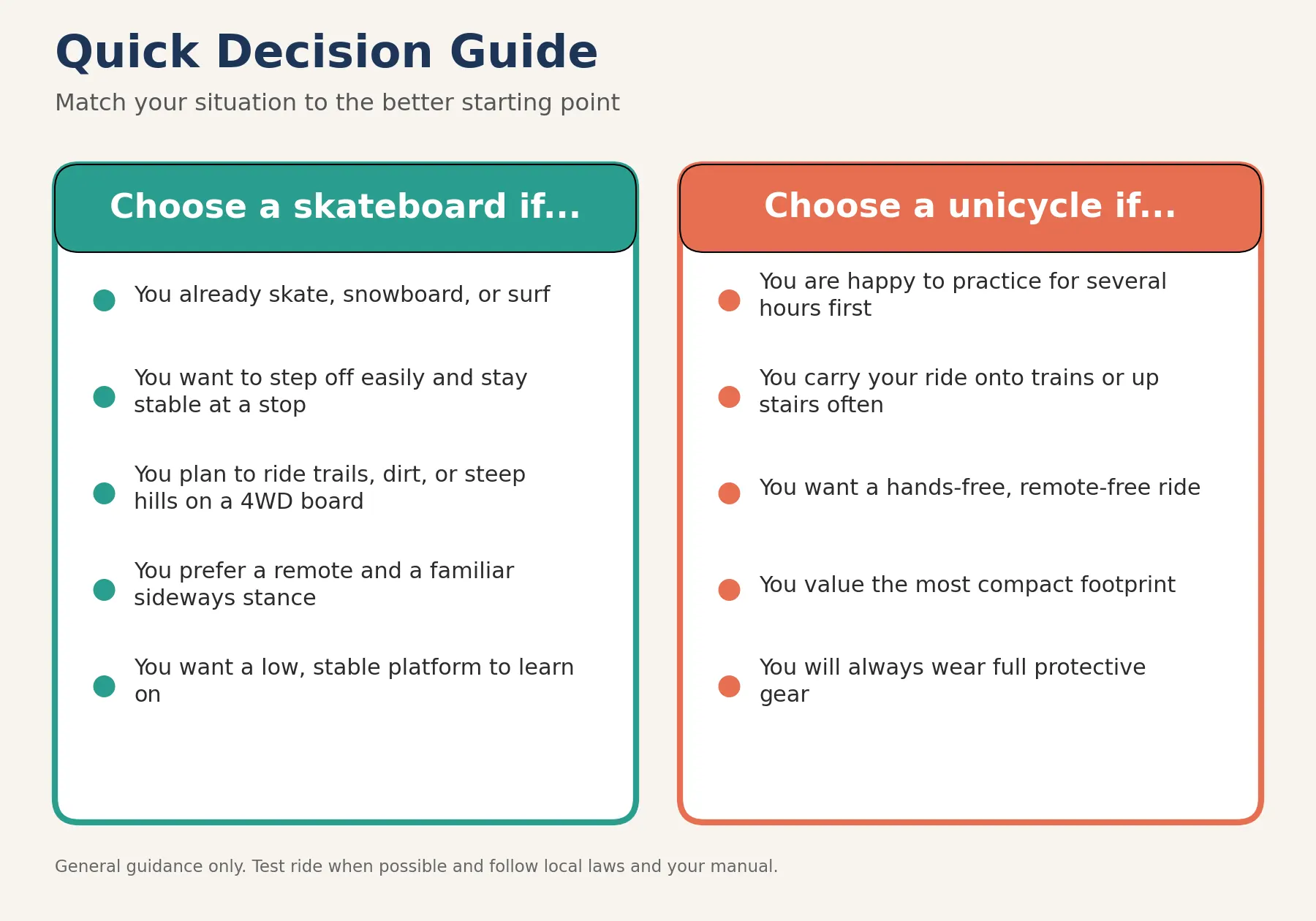
An electric skateboard is usually the better fit if:
- You are new to personal electric vehicles and want a gentler learning curve
- You already have board-sport experience
- You want to ride trails, dirt, or steep hills with a purpose-built all-terrain board
- You value being able to step off quickly and stay stable at a standstill
- You want a ride that suits commuting, cruising, and carving
An electric unicycle may suit you better if:
- Compactness and a trolley-handle carry are your top priorities
- You are comfortable investing practice time before you are confident
- You like the idea of a remote-free, hands-free ride
- You will always wear full protective gear
If you are weighing other options as well, we also compare electric skateboards with electric scooters and with the Onewheel.
Ready to Choose?
If a skateboard sounds like the right fit, the Find Your Perfect Board tool matches boards to your riding style, and the compare all boards page puts specs side by side. Commuters can start with the ET Pro 2.0, and riders who want to leave the pavement can look at the M24 Pro. You can also browse everything in the electric longboard and street series or the full electric skateboard lineup.

