


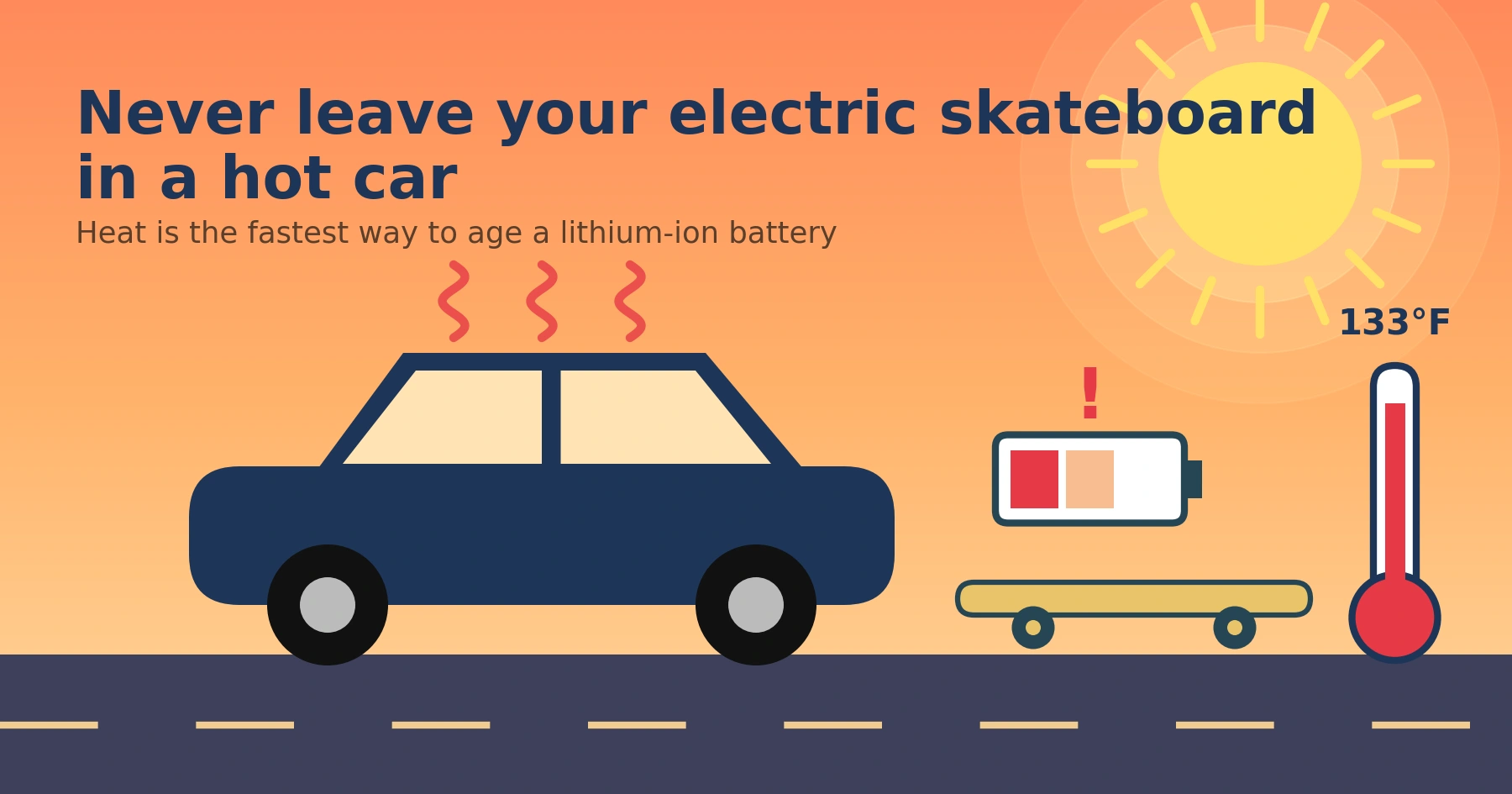
| A parked car can reach 130°F in an hour. Learn how heat damages electric skateboard batteries, the warning signs to watch for, and how to transport your board safely in summer. |
You finish a great ride, toss your board in the back seat, and head into a store for “just a few minutes.” It feels harmless. For the battery inside your electric skateboard, it can be one of the most damaging things you do all summer.
Heat is the enemy of every lithium-ion battery, and a closed car is one of the fastest ways to create it. This guide explains how hot a parked car really gets, what that heat does to your board, how to spot damage, and how to transport and store your board safely when temperatures climb.
How Hot Does a Parked Car Really Get?
Most people underestimate how quickly a car heats up. Research from Stanford University School of Medicine, published in the journal Pediatrics in 2005, tracked the inside of parked cars on days when the outside temperature ranged from 72°F to 96°F. On average, the cabin warmed by roughly 19°F in the first 10 minutes, 29°F in 20 minutes, 34°F in 30 minutes, and 43°F after an hour.
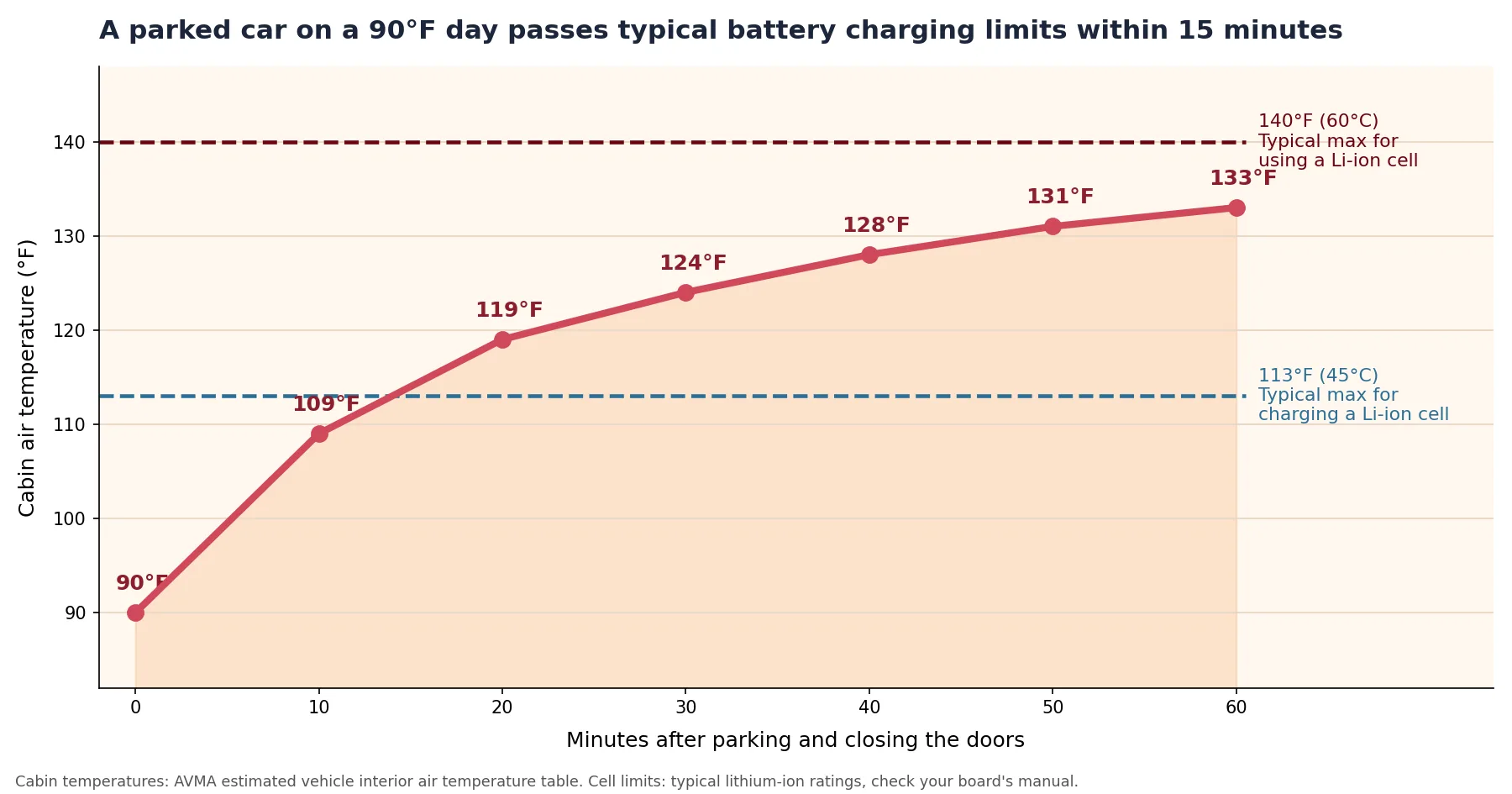
The American Veterinary Medical Association publishes a table based on similar data. On a 90°F day, it estimates the inside of a car reaches about 109°F after 10 minutes and about 133°F after an hour. On a 95°F day, the figures rise to roughly 114°F and 138°F.
Those numbers describe the cabin air. Surfaces in direct sun get even hotter. The same research notes that dark dashboards and seats often reach 180°F to more than 200°F. A dark deck or battery enclosure in a sunny window can therefore run hotter than the surrounding air.
What Heat Does to an Electric Skateboard Battery
Electric skateboards use lithium-ion battery packs, and these cells have a comfortable operating temperature range. According to widely cited guidance from Battery University, lithium-ion cells can typically be discharged (used) between about -20°C and 60°C (-4°F to 140°F), but should only be charged between about 0°C and 45°C (32°F to 113°F). Many battery guides recommend storing packs at roughly 10°C to 25°C (50°F to 77°F), ideally at a partial charge rather than a full charge.
Staying within those ranges matters because heat can cause chemical changes.
It speeds up aging. Lithium-ion batteries tolerate warmth, but prolonged exposure to high temperatures shortens their lifespan. Heat accelerates the unwanted side reactions inside the cell that slowly reduce capacity. In practical terms, a pack that spends repeated afternoons in a hot car can lose range faster than one stored indoors.
It makes charging riskier. Charging a hot battery is more stressful than discharging one. Charging above roughly 45°C degrades the cells, which is why a board that has been baking in a car should not go straight onto the charger.
It raises safety risks in extreme cases. Thermal runaway happens when a cell generates heat faster than it can shed it, causing a rapid, uncontrolled temperature rise. It is uncommon, and quality packs include protection circuitry (a battery management system, or BMS, explained in our electric skateboard glossary). But a BMS is a safety net, not permission to leave a pack in extreme heat. Prolonged heat, physical damage, and poor charging habits all increase the odds of a problem.
“But I Only Left It for Ten Minutes”
The data above shows why short stops are not as safe as they feel. On a hot day, the cabin can pass the typical charging limit within about 15 minutes, and the temperature keeps climbing from there.
Two common ideas do not help much:
- Cracking the windows. The Stanford study found that leaving windows cracked made little difference, reducing the temperature rise by less than 3°F.
- Using the trunk. A trunk is enclosed, gets no air conditioning, and can trap heat just as well as a cabin. It also hides the board from you, which makes it easy to forget.
If you want to understand how heat affects the rest of your riding, our guide to riding an electric skateboard safely in summer heat covers pacing, battery temperature, and what to watch for on the road.
Warning Signs Your Battery May Have Been Overheated
After any heat exposure, give your board a quick inspection before you ride or charge it. Look and listen for these signs:
- Swelling or bulging in the battery enclosure or deck
- A warped, cracked, or deformed case
- A chemical or sweet odor coming from the board
- Unusual heat when you touch the battery area, even after the board has cooled
- Sudden range loss or a battery percentage that drops much faster than normal
- Power cutting out under moderate load
Any one of these can mean the pack has been stressed. A visibly swollen or foul-smelling battery is a stop-using-it situation, not a wait-and-see one.
What to Do If Your Board Was Left in a Hot Car
If you realize your board spent time in a hot vehicle, take these steps in order:
- Move it somewhere cool and shaded. Let it return to room temperature on its own. Do not use ice, a freezer, or cold water, since rapid temperature changes can cause their own damage.
- Do not charge it yet. Wait until the battery area feels close to room temperature to the touch, which can take a while after a hot trip.
- Inspect it. Run through the warning signs above, and check the deck, wheels, and remote as well.
- Test gently. If everything looks normal, take a short, low-speed ride and watch for power loss or unusual behavior before trusting it on a longer trip.
- Stop and get help if anything seems off. If you notice swelling, an odor, or excess heat, stop using the board and keep it away from flammable materials. Review the Ecomobl safety precautions, check your board’s user manual, and contact the support team for guidance. It is also worth reading the warranty and legal terms so you know how heat exposure is handled.
For smaller issues, such as a board that will not power on or charging that seems off, our article on e-board problems you can solve without contacting customer service is a useful first stop.
How to Transport and Store Your Board in Hot Weather
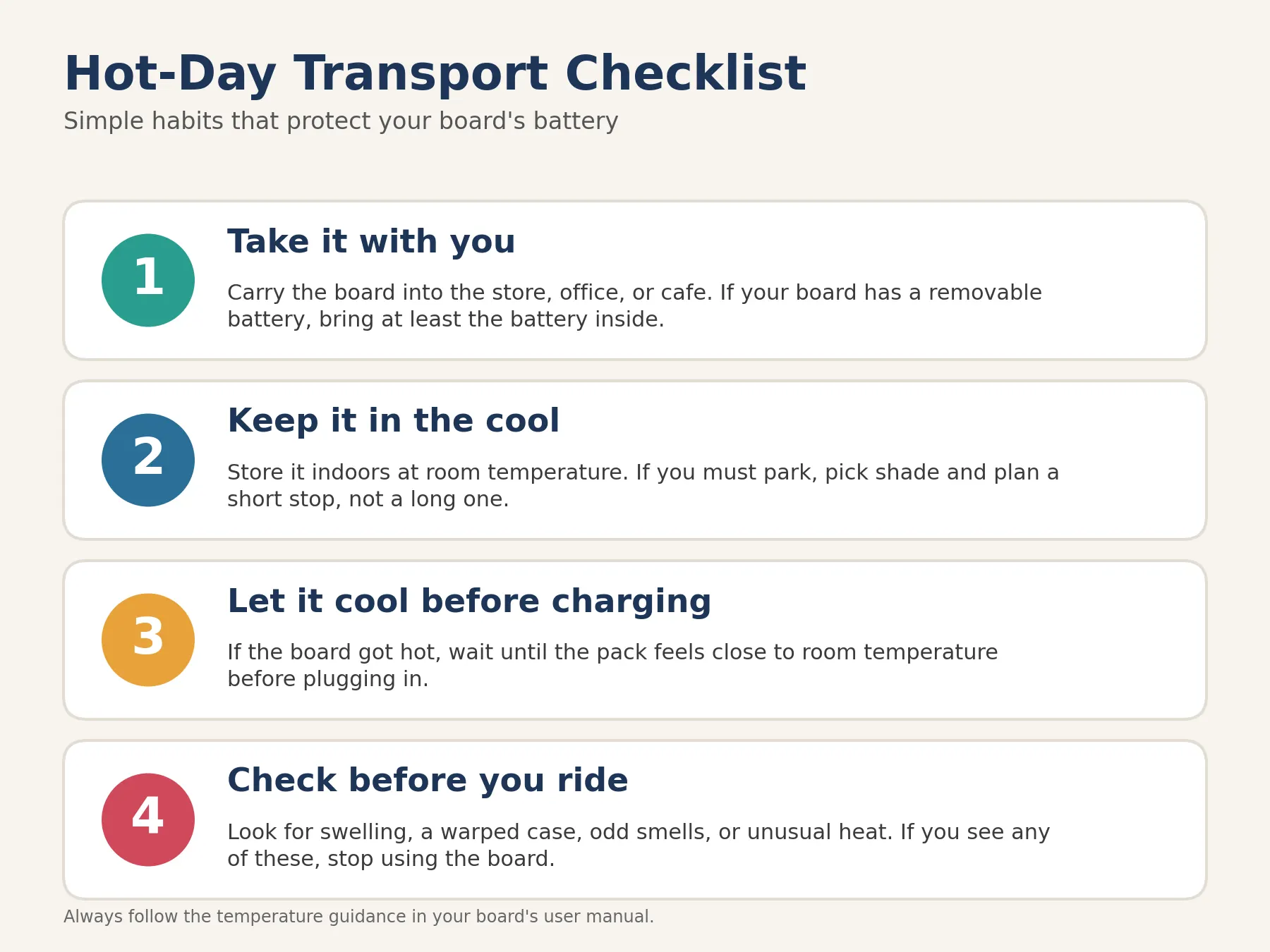
Take it with you. The simplest rule is the best one. Carry the board into the store, office, or restaurant. If your board uses a removable pack, you can bring just the battery inside, a major advantage covered in our look at electric skateboards with removable batteries.
Choose a cool place at home. Store your board indoors at normal room temperature, not in a hot garage, shed, or on a sunny balcony.
Use shade and short stops if you must park. If you absolutely have to leave the board in a vehicle briefly, park in full shade, keep the stop short, and never leave it for hours. Treat this as a last resort, not a routine.
Let it cool, then charge. After a hot ride or a hot trip, give the battery time to settle to room temperature before plugging it in.
Avoid charging in a hot space. Charge in a cool, ventilated room away from flammable items and out of direct sun.
Plan for the off-season too. Heat is one risk and long storage is another. When summer ends, our guide on storing your electric skateboard properly during winter explains how to keep the battery healthy over several months.
If you are building better habits overall, our list of things you should not do with an electric skateboard is a good companion read.
People Also Ask
Can I leave my electric skateboard in the car if it is not that hot outside?
It is still risky. In the Stanford research, cars warmed by roughly 19°F in 10 minutes even on mild, sunny days, so a 75°F day can still produce a cabin well above 90°F. The safest habit is to bring the board with you.
How hot is too hot for an electric skateboard battery?
Lithium-ion cells are typically rated to be used up to about 60°C (140°F) and charged up to about 45°C (113°F). Check your board’s manual for its specific limits, and avoid anything close to those numbers for long periods.
Is it safe to charge my board right after leaving it in a hot car?
No. Let it cool to room temperature first. Charging while the pack is hot adds stress to the cells and can speed up degradation.
Will heat exposure permanently reduce my battery range?
It can. Repeated or prolonged heat accelerates aging, which shows up as lower capacity and shorter range over time. A single short exposure may cause little noticeable harm, but repeated exposure adds up.
Does an insulated bag protect the battery?
At best, it may slow the rate of heating for a short time. It will not keep a pack cool for hours in a hot car, so it is not a substitute for taking the board or battery with you.
The Bottom Line
A hot car is one of the easiest ways to damage an electric skateboard battery without realizing it. The fix costs nothing: take your board with you, store it somewhere cool, and let it cool down before charging. Those small habits protect your range, your investment, and your safety all summer long.
Looking for more battery and riding guidance? Browse the full Ecomobl blog for practical guides on maintenance, safety, and getting more from your board.

