


Three Minutes at a Coffee Shop
The scenario below is an illustrative composite, written to show how these thefts typically unfold. It is not a report about a specific person.
Most Saturday mornings, Daniel rides his electric skateboard to a coffee shop in Long Beach, California. It is a ten-minute ride from his apartment, and the shop has a narrow stretch of sidewalk out front where he usually props the board against the wall beside the window.
This Saturday, there are six people ahead of him in line. He glances at the board through the glass, orders, and turns to grab a napkin and a lid. When he looks back, the wall is empty.
He steps outside and checks both directions. Nothing. The shop’s cameras cover only the register and the pastry case. A few minutes later, a police officer takes his report and asks two questions he cannot answer: what is the serial number, and does he have proof of purchase? He never wrote the serial number down. The receipt is somewhere in an email account he has to dig through that evening. There is no tracker on the board, no photo of it with him standing beside it, and no lock, because it only ever sat outside for a few minutes.
The officer is honest with him. Without identifying details, even a recovered board is hard to match to its owner. Because an electric skateboard is worth far more than $950, taking it counts as grand theft under California Penal Code section 487, a serious offense on paper. In practice, it does not help much if there is nothing linking the board to the person reporting it.
Nothing about Daniel’s morning was unusual, and that is the point. He did not make one big mistake. He skipped five small habits, and any one of them would have changed how the day ended. This guide walks through those five layers.
Why Electric Skateboards Attract Thieves
Several factors make an electric skateboard an appealing target. It is valuable, easy to carry off under an arm, quick to resell, and awkward to secure compared with a bicycle, which has a frame built to be locked to a rack. Thieves tend to be opportunistic, and an unattended board that nobody is watching is exactly that kind of opportunity.
The good news is that opportunistic thieves are also the easiest to discourage. Most of what follows is about making your board a little more trouble than the next one.
The Five Layers of Protection
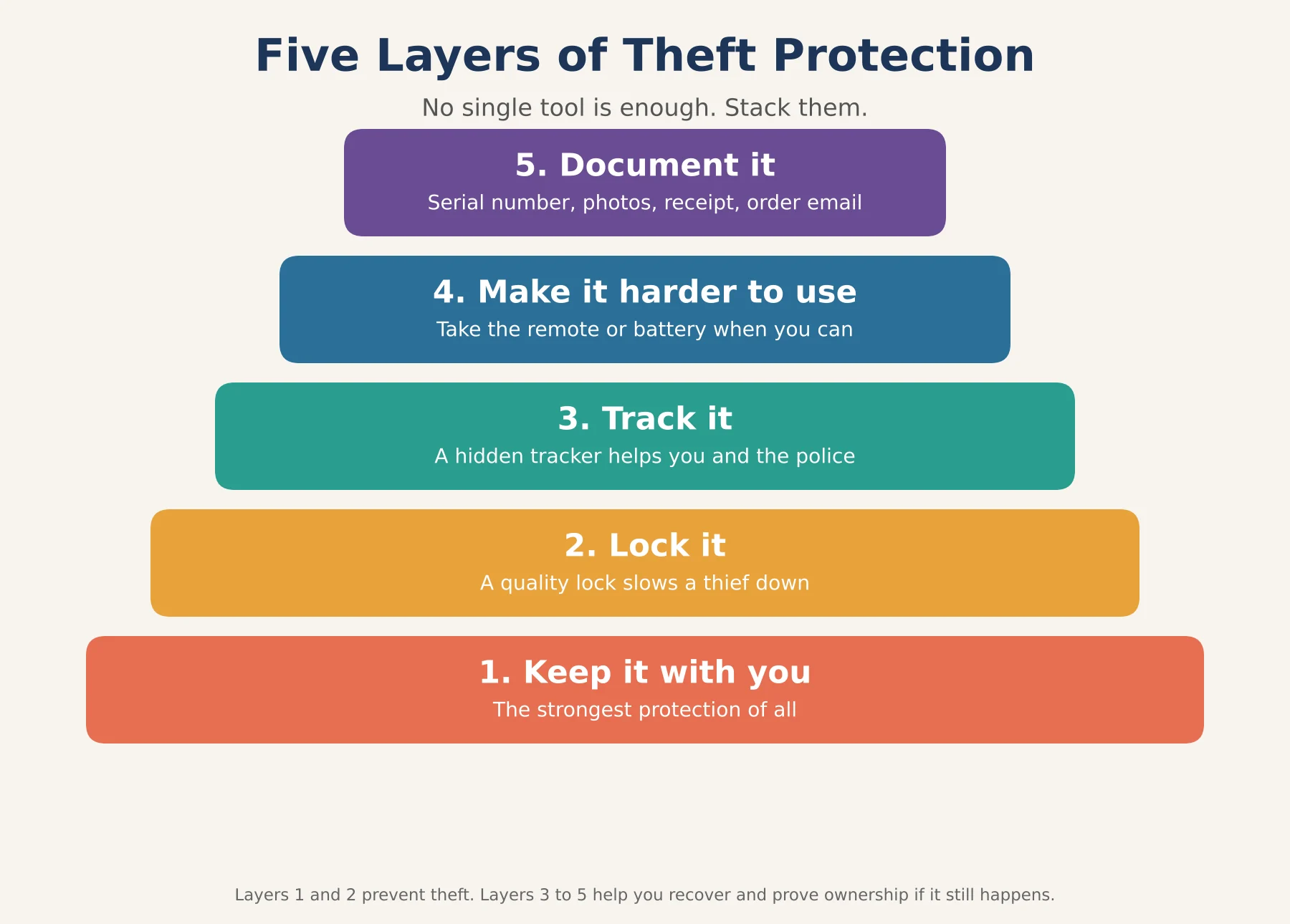
No single tool is enough. Locks can be cut, trackers can be found, and documents only help after the fact. Stacked together, though, they change the odds considerably.
Layer 1: Keep It With You
The most reliable theft prevention is never leaving your board where you cannot see it. This sounds obvious, but it is the habit that would have saved Daniel’s board.
A few practical rules help:
- Follow the sightline rule. If you cannot keep your eyes on it, carry it. A board leaning outside a window while you stand in line is still unattended.
- Bring it inside. Many cafes, offices, and shops are fine with a board tucked beside your table or under a counter, especially if you ask. Our guide to riding through the city covers how riders handle this on mixed errands.
- Plan around weight. A compact board like our Supermini, at roughly 23 to 25 pounds, is far easier to carry into a store than a large all-terrain board such as the M24 2WD, which weighs 54.5 pounds. If your routine involves lots of short stops, portability is a real security feature.
- Take the removable parts. If your board has a removable battery, you can take it with you. We cover how that works in our look at electric skateboards with removable batteries. Bringing the remote along also makes a board harder to ride away, although it will not stop someone who simply carries it off.
- Do not leave it in a vehicle. A board visible in a parked car invites a break-in, and a closed car is hard on the battery as well, as we explain in our article on why you should never leave your board in a hot car.
Layer 2: Lock It
Locking a skateboard is harder than locking a bike, and it is worth being honest about the limits. A skateboard has no frame to run a lock through, and a determined thief with tools can sometimes remove parts such as trucks. A lock slows a thief down and discourages the casual grab, but it does not make leaving a board for an hour safe.
When you do lock up for a short stop, the guidance from police departments is consistent, even though it is written for bicycles:
- Choose a solid steel U-lock or a heavy chain over a cable lock. The San Francisco Police Department says a high-end steel U-lock is best because cheap locks and cables are easily cut. The Seattle Police Department notes that most stolen bikes are either unlocked or secured with poor-quality cable locks.
- Keep the lock tight. The Los Angeles Police Department advises tightening the lock as much as possible, or placing it close to the fixture, so thieves have no room to use bolt cutters, as reported by NBC Los Angeles.
- Lock to something solid. Use a fixed rack or post that cannot be lifted, cut, or unbolted, and avoid flimsy signs and small trees.
- Take loose accessories with you. The Portland Police Bureau recommends removing easily detachable accessories before you walk away, and the same applies to lights, bags, and remotes.
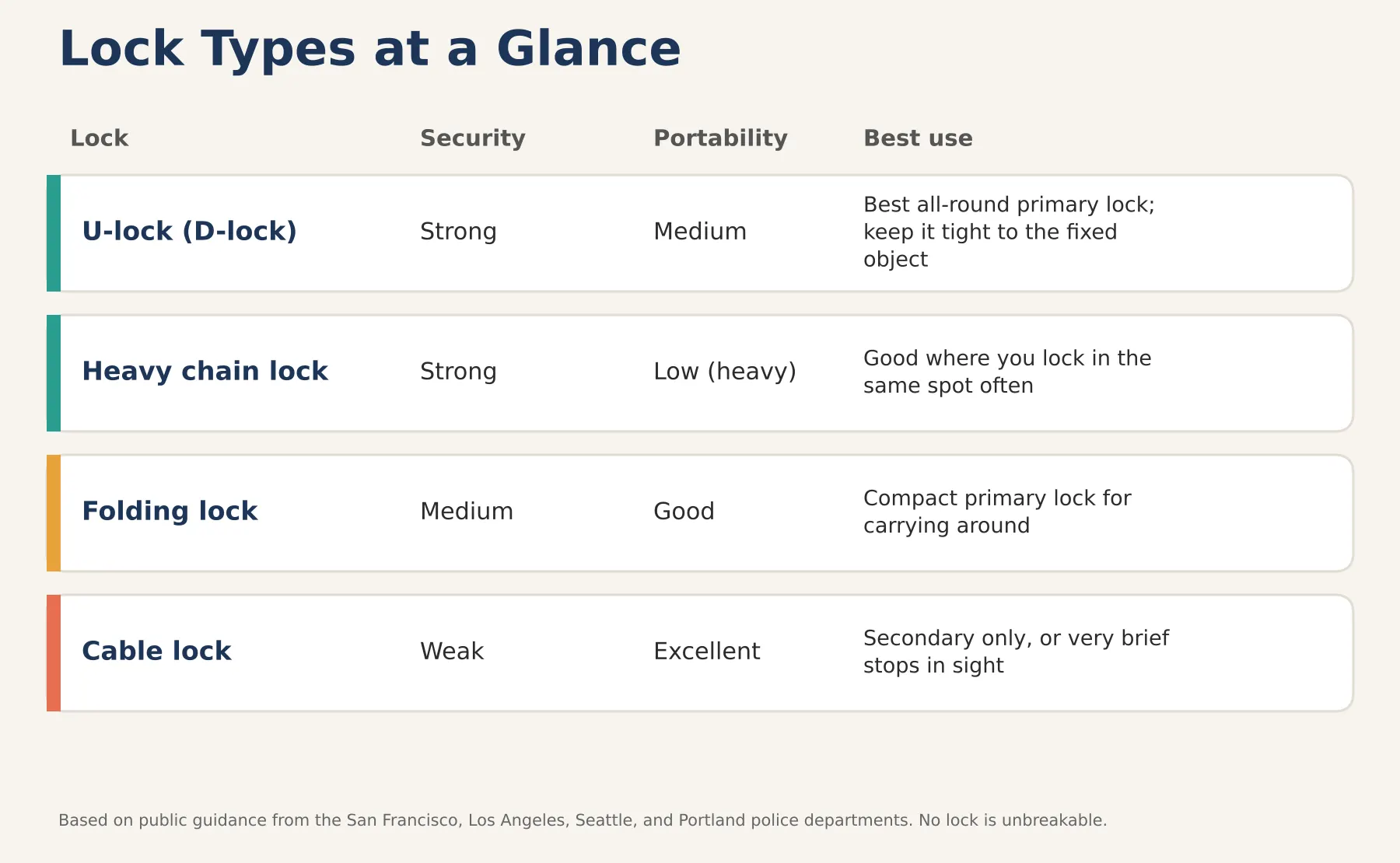
If you choose a lock, pick the strongest one you are willing to carry. A cable lock is fine as a secondary measure or for a quick stop where you can see the board the whole time, but it should not be your only protection.
Layer 3: Track It
A tracker will not stop a theft, but it can change what happens afterward. There are two broad types.
Bluetooth item trackers such as Apple AirTags, Tile, and Samsung SmartTags are small, inexpensive, and use nearby phones to report their location. GPS trackers with cellular service can report location more directly, but they cost more, often require a subscription, and need charging.
Some honest caveats apply to both:
- Thieves may be alerted. iPhone users receive notifications when an unknown AirTag is traveling with them, and many Android phones give similar warnings, according to Cult of Mac. That feature exists to protect people from being stalked, but it also means a thief can discover your tracker.
- They are not designed as anti-theft devices. Apple has avoided marketing AirTags as a way to recover stolen property, as noted in reporting republished by The Philadelphia Inquirer.
- Location can be approximate. A tracker may show you a general area rather than a specific door.
Placement matters. Choose a spot that is hard to see and does not interfere with the board’s electronics. Do not open the battery compartment or drill into the board, since that can create safety problems and affect coverage. Check your user manual and the warranty terms before modifying anything, and consider attaching the tracker to something less invasive, such as your carry bag.
Most important of all: do not chase your tracker. Police officers across the country, including those from the Denver Police Department as quoted by Axios, advise against attempting to recover tracked property yourself because confronting a suspect is dangerous. Share the location with the police and let them handle it.
Layer 4: Make It Harder to Use
Take the remote with you whenever you step away. It will not stop a thief who carries the board off, but it removes the easy option of riding away, and it prevents the board from being used on the spot. Also check your manual to see whether your board offers any security-related settings, and never assume a feature exists unless the manufacturer documents it.
Layer 5: Document It
This is the layer Daniel skipped, and it is the one that makes everything else more useful. If your board is stolen and later recovered, police need a way to connect it to you.
- Record the serial number and keep it somewhere you can access from your phone, such as a notes app or cloud folder. Your user manual and the label on your board can help you find it.
- Take clear photos of the entire board from several angles, plus any scratches, stickers, or other unique marks. Include one photo of you with the board.
- Save your receipt and order confirmation in the same place. If you ever need an invoice copy, the Ecomobl team can help you retrieve your order details.
- Check your insurance. Some renter’s and homeowner’s policies cover personal property, but terms, limits, and exclusions vary, and items stolen from vehicles or left unattended may be treated differently. Ask your insurer before you need to.
The Seattle and San Francisco police departments give the same advice for bicycles: record the serial number, take photos, and keep proof of ownership, because few stolen items are returned without them.
Where Boards Actually Disappear
Thefts tend to cluster in predictable places. Knowing them helps you adjust your habits:
- Coffee shops and quick errands. The short stop is where most people relax, which is why it works for thieves.
- Campuses. Boards left in hallways, bike racks, and common areas are easy targets. Our guide for college students covers riding and storing a board on campus.
- Apartment buildings and garages. Shared halls, lobbies, and open garages offer little protection. Keep your board inside your unit when possible, and see our advice on storing your board properly for good indoor habits.
- Vehicles. Boards visible through car windows are an easy find for anyone breaking in.
If you are using your board as everyday transportation, as we describe in our article on living car-free with an electric skateboard, a few consistent habits matter more than any one product.
If Your Board Is Stolen
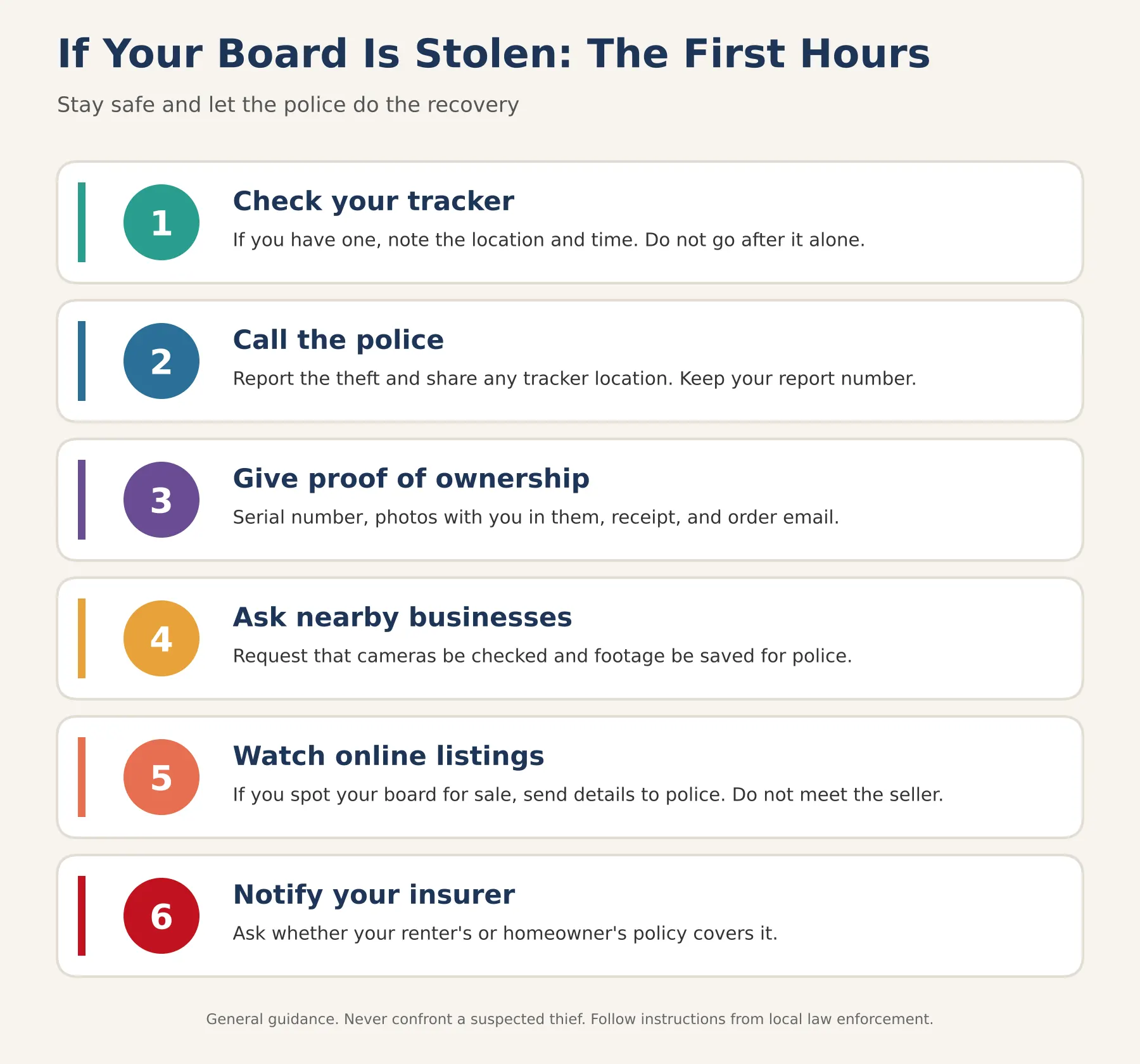
Stay calm and act quickly, but safely:
- Check your tracker, if you have one, and note the location and time. Do not go after it yourself.
- Call the police and file a report. Share any tracker location. Keep your report number.
- Provide proof of ownership, including the serial number, photos, and receipt.
- Ask nearby businesses whether their cameras might have captured the area, and ask them to save any footage for the police.
- Watch online listings. If you see your board for sale, send the details to the police and do not meet the seller on your own.
- Contact your insurer if you have a policy that might apply.
Quick Anti-Theft Checklist
- Carry it in whenever you cannot see it
- Use a quality U-lock or chain for short stops, and keep it tight
- Hide a tracker somewhere safe, and never chase it
- Take the remote and battery when you can
- Store the serial number, photos, and receipt where you can find them
- Keep it indoors at home, not in a hallway or open garage
- Never leave it in a parked vehicle
Make Carrying Easier
Portability is one of the best anti-theft features a board can offer. If you run many short errands, consider our compact Supermini, or use the Find Your Perfect Board tool to match a board to your riding style.
This article provides general information and is not legal or insurance advice. Never confront a suspected thief, and follow the guidance of local law enforcement.

