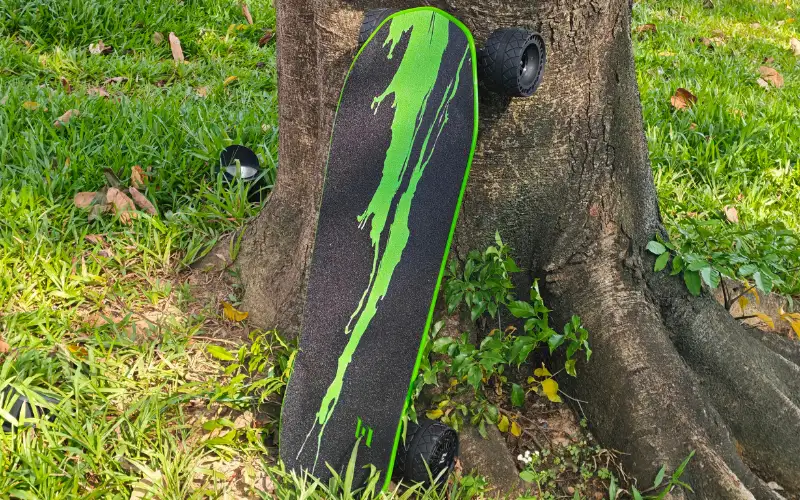


Most electric skateboards fall apart the moment the pavement does. Standard boards use small, hard wheels built for one job: rolling on smooth asphalt. Hit a crack, a patch of gravel, or a stretch of grass, and the ride turns rough or stops completely.
All-terrain electric skateboards exist to fix that. Three things separate them from a standard e-board: bigger, softer wheels that grip loose ground, a build tough enough to survive vibration and moisture, and a motor with enough torque to push through sand, dirt, and hills. Here’s a breakdown of each, along with how these features actually show up on real boards.
What is an All-Terrain Electric Skateboard?
A standard electric skateboard is a deck fitted with a lithium battery, a motor, an electronic speed controller (ESC), and a wireless remote. Sensors read your remote input and tell the motor to accelerate or brake. That setup works fine on flat streets, but the small polyurethane wheels, usually 70 to 80mm, run out of grip the moment the surface changes.
Because these boards have no suspension and only a small contact patch, most standard e-boards struggle wherever a smooth surface turns rough. Grass, gravel, and dirt paths sit outside what a typical board can handle, which is the specific gap all-terrain models are built to close.
Standard vs. All-Terrain Electric Skateboards at a Glance
| Feature | Standard Electric Skateboard | All-Terrain Electric Skateboard |
| Wheel diameter | 70 – 80 mm, hard polyurethane | 100 – 150 mm, softer urethane or pneumatic |
| Suspension | Rarely included | Common on higher-end models |
| Deck construction | Single-layer maple or plastic | Multi-layer maple, bamboo, or carbon fiber |
| Water resistance | Minimal to none | IP65-rated on most models |
| Motor power | Roughly 300-1000W | Roughly 500-2000W |
| Hill-climbing | Limited, best on flat ground | Built for 25%+ grades |
| Best suited for | Sidewalks, bike lanes, campus paths | Trails, grass, gravel, dirt, hills |
1. Wheels: Built for Any Surface
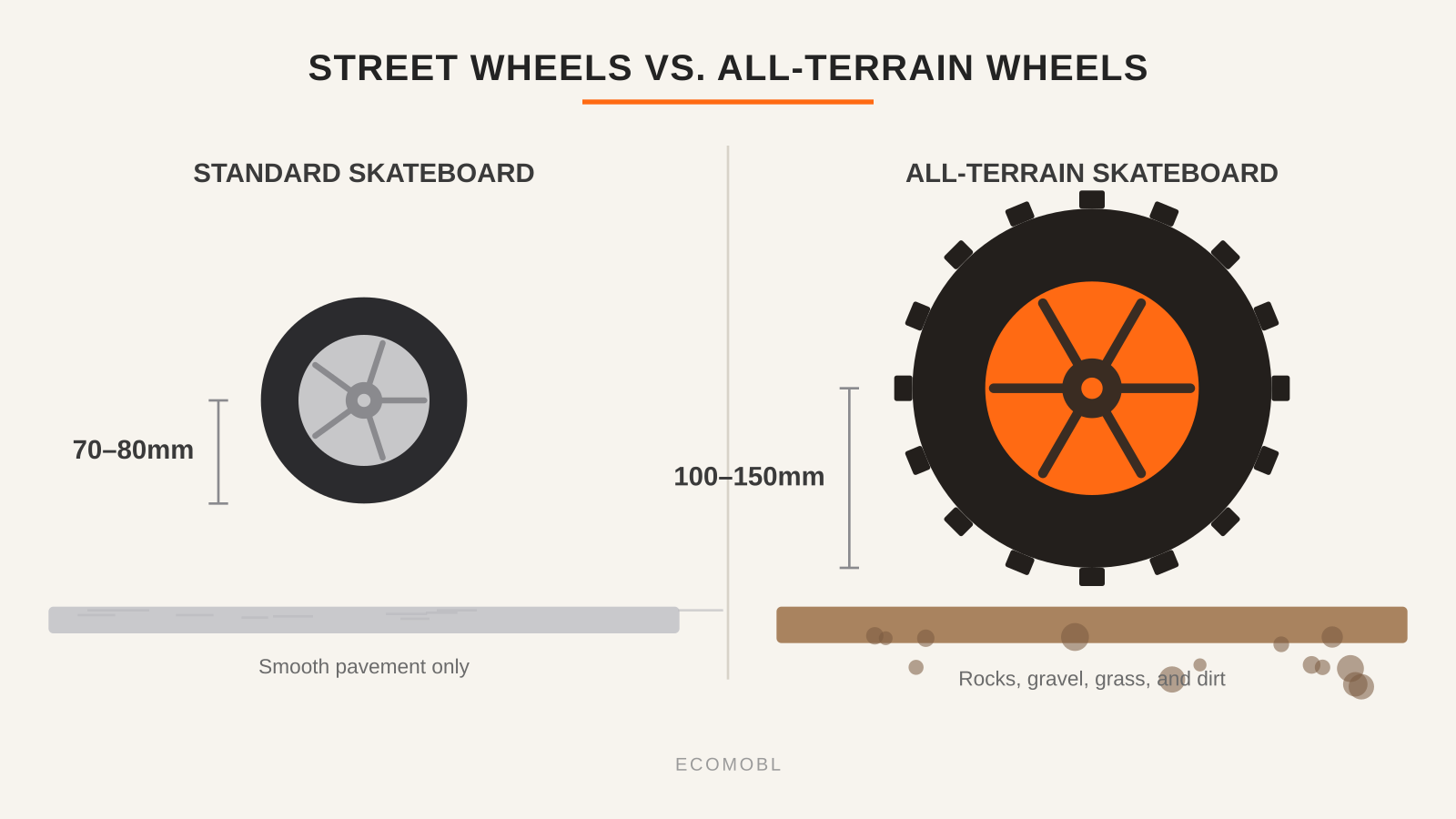 Standard wheels top out around 80mm. All-terrain wheels run up to 150mm with deeper tread for loose ground.
The wheels are the most obvious upgrade, and the one that matters most. All-terrain wheels run 100 to 150mm in diameter, roughly double the size of a standard board’s wheels, which lets them roll over rocks, cracks, and dips instead of getting stopped by them. The extra size also adds rotational mass, which smooths out vibration and keeps the ride steady once the ground gets uneven.
A few other differences show up in the wheels themselves:
- Shock absorption. Softer urethane and rubber compounds soak up impacts instead of transmitting them straight to the deck.
- Deep tread patterns. Grooves and knobs bite into grass, dirt, and loose gravel the way a smooth wheel simply cannot.
- Air-filled (pneumatic) tires. Similar to mountain bike tires, these flex around obstacles for a cushioned ride, though they can puncture.
- Airless urethane tires. A trade-off in comfort for a tire that never goes flat and needs almost no upkeep.
With this setup, all-terrain boards can cross cracked sidewalks, packed trails, and grassy fields that would stop a standard board cold. The Ecomobl M24 Pro, for example, pairs 250mm wheels with a planetary gear drive built into the wheel hub itself, rather than a belt running alongside it, which keeps the drivetrain shielded from mud and debris while still delivering enough torque to climb a 47 to 55 percent grade.
2. Durability: Engineered for Tough Rides
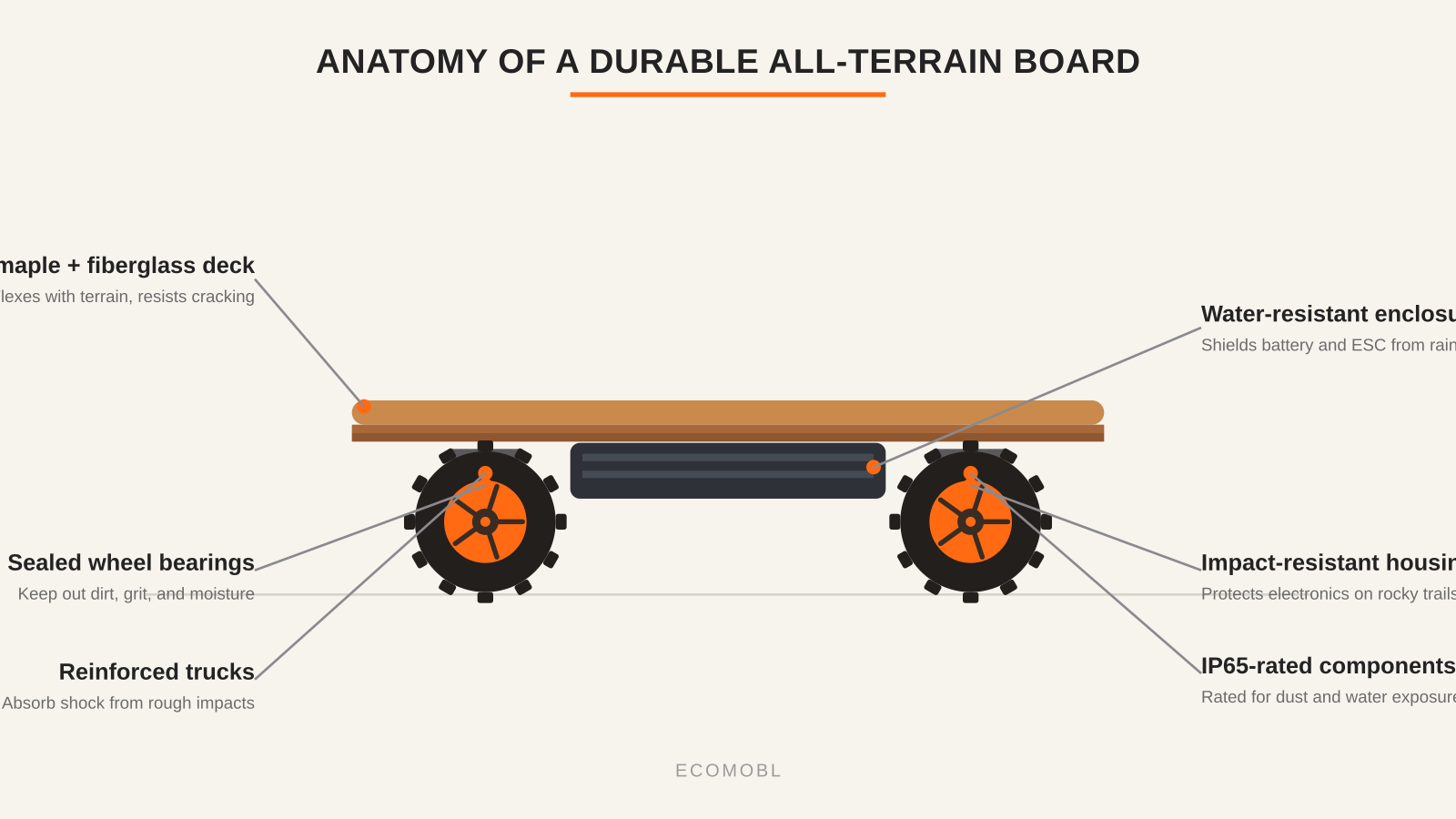 The parts that take the most abuse off-road are bearings, trucks, deck layers, and the electronics enclosure.
Off-road riding puts far more stress on a board than a flat commute ever will. Every bump, root, and pothole works its way through the wheels and into the trucks, deck, and electronics, which is why board reliability comes down to a handful of specific build choices rather than any single feature. Many all-terrain decks use layered maple, bamboo, or carbon fiber, materials chosen because they flex slightly under load instead of cracking.
Durability on these boards usually comes down to a few specific things:
- Water resistance. Sealed housings keep puddles, mud, and rain out of the electronics, typically rated to IP65.
- Sealed bearings. Dirt and grit are the main cause of premature wheel wear, and sealed bearings keep both out.
- Reinforced trucks. Aluminum or CNC-machined trucks absorb repeated shock without loosening or bending over time.
- Protective casings. Battery and ESC compartments get extra shielding against impacts and moisture.
The Hybrid X5 is a good example of what this looks like in practice. It uses a 21-layer carbon fiber deck and battery case, aluminum CNC-machined trucks, and a sealed, waterproof ESC rated at 60 amps, a combination built specifically to hold up over repeated trail use rather than the occasional bumpy sidewalk.
3. Motor and Power: Climbing Any Terrain
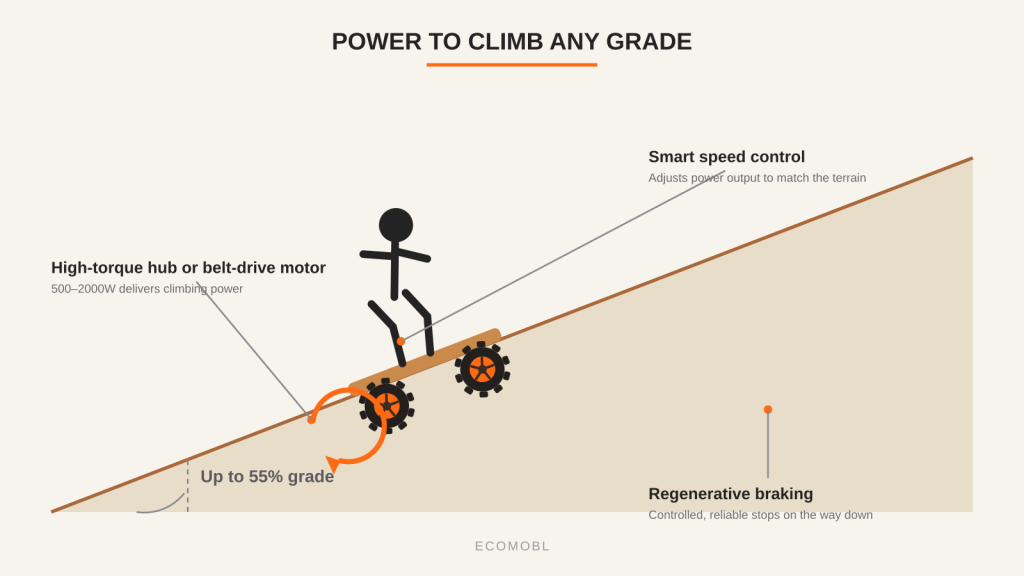 Torque, not top speed, is what gets a board up a loose or steep grade.
A rugged build only gets a rider so far. Grass, sand, and hills all add resistance that a small motor can’t push through, which is why all-terrain e-boards lean on high-torque motors, typically in the 500 to 2000W range, to keep speed and control consistent as the terrain changes underneath the wheels.
A few components do most of the work here:
- Belt-drive or planetary gear systems. Both multiply torque for climbing, though gear drives tend to stay cleaner since the mechanism sits inside the wheel hub.
- Smart speed control. The electronic speed controller governs how power reaches the motor, adjusting output based on load so the board doesn’t lurch on loose ground the way a fixed throttle curve would.
- Reliable brakes. Regenerative braking slows the board smoothly on descents, which matters more on a rough downhill than it ever does on flat pavement.
- Swappable motor or battery modules. Some boards let riders customize power output or swap in a second battery for longer rides.
The Telum BA shows what this looks like at the higher end: four 3,750W motors (15,000W combined) paired with dual 75A ESCs, enough to hold a 47 to 57 percent grade while staying stable on loose or uneven ground. For riders who spend more time on rolling terrain than steep climbs, it’s worth reading up on how motor and battery choices affect performance on hilly routes before deciding how much power is actually needed.
Other Features Worth Considering
Beyond wheels, build quality, and motor power, most all-terrain boards include a few smaller features that add up:
- Shock-absorbing flex decks that reduce fatigue on longer rides
- LED headlights and taillights, useful for both visibility and low-light riding
- Higher ground clearance to clear rocks, roots, and debris
- Water resistance rated to IP65 or better
- Removable batteries that extend range without adding to the board’s static weight
Who Should Buy an All-Terrain Electric Skateboard?
Not every rider needs the biggest wheels or the most powerful motor. Someone commuting across a paved campus is better served by a lighter board, while someone riding unpaved trails or steep neighborhood streets needs the wheel size and torque an all-terrain board provides. Riders just getting started or looking for something more capable than a standard board without going all-in on off-road specs tend to land on a lighter all-terrain option like the M24 2WD, which handles light trails, grass, and everyday routes without the size or price of a full 4WD mountain board. Riders working with a tighter budget can also start with a general buying guide built around range, price, and realistic expectations before deciding how much off-road capability is actually worth paying for.
Final Thoughts
The gap between a standard electric skateboard and an all-terrain one comes down to those three features: wheels built to grip loose ground, a build tough enough to survive vibration and moisture, and a motor with the torque to push through hills, grass, and sand. Whether that means a lighter board for occasional trail use or a full 4WD setup for steep, rough terrain, the full lineup of off-road models covers a fairly wide range of riders. Cracked sidewalks, grassy parks, and gravel trails stop being obstacles once the board underneath is built for them.