


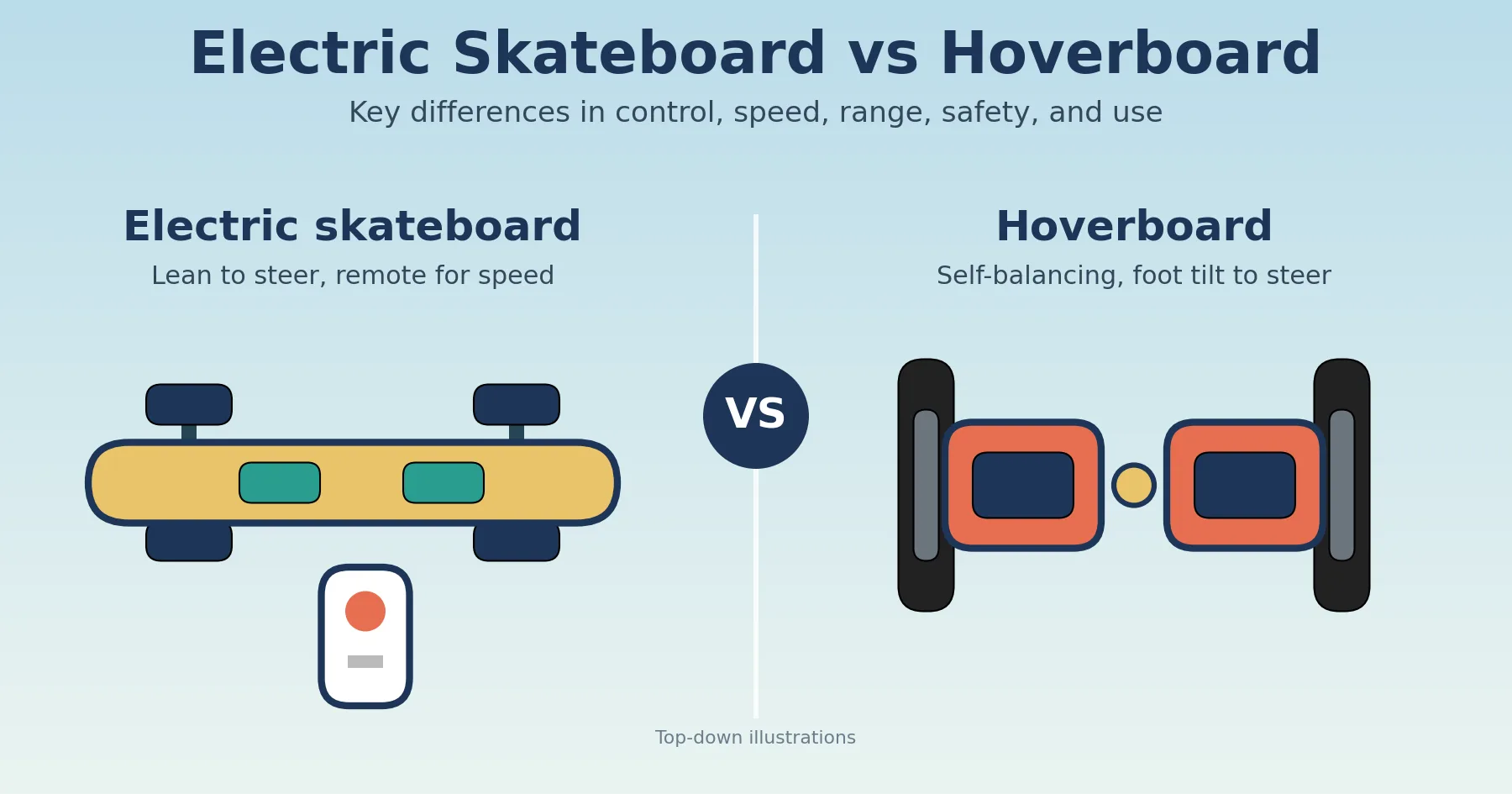
People often use “hoverboard” and “electric skateboard” interchangeably, especially when shopping for a gift. They are not the same. Both are battery-powered, and you stand on them, but they work and ride differently and suit very different people and places.
A hoverboard is a self-balancing, two-wheeled scooter without a handlebar, controlled by tilting your feet. An electric skateboard is a powered skateboard that you balance on yourself and accelerate with a handheld remote. That one difference changes almost everything else, from top speed and range to who should ride which.
This guide compares them on the key points, using official safety data and published specifications so you can make a confident choice.
The Short Answer
- Choose an electric skateboard if you want real speed, longer range, hill and rough-ground capability, and a ride that grows with your skills. It suits commuting, trails, and teens and adults who want a serious personal vehicle.
- Choose a hoverboard if you want a compact, low-speed, easy-to-learn ride for short, flat distances, often for younger riders and casual fun.
- Buying for a child or as a gift? Check age guidance and safety certification first, since speed, skill, and fire safety matter more than looks.
What Is a Hoverboard?
A hoverboard, also called a self-balancing scooter, has two motorized wheels connected by a platform with a footpad on each side. Gyroscopes and sensors inside constantly adjust the wheels to keep you upright, and pressure-sensitive pads detect how you shift your feet. Lean both feet forward,d and it moves ahead;d, tilt one foot more than the other, and it turns. There is no remote and nothing to hold.
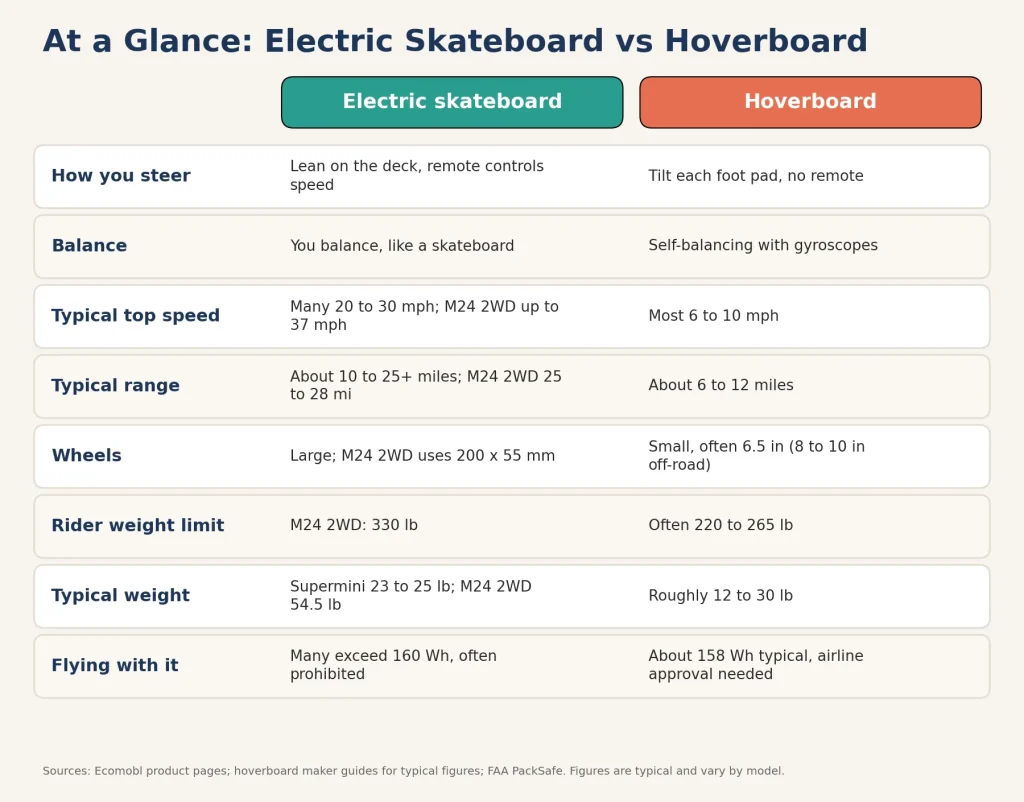
Most hoverboards top out at about 6 to 10 miles per hour, with a few performance models reaching around 12, according to hoverboard makers’ own guides such as Gyroor’s explanation of how they work. Typical rider weight limits run from about 220 to 265 pounds, wheels are usually small (around 6.5 inches on common models, larger on off-road versions), and real-world range is often in the neighborhood of 6 to 12 miles.
What Is an Electric Skateboard?
An electric skateboard consists of a deck, trucks, wheels, a battery, and one or more motors. You stand sideways, steer by leaning, as on a regular skateboard, and control speed with a wireless remote. Nothing balances for you, so skill matters more, but the payoff is far greater capability. For a closer look at the mechanics, our explanation of how electric skateboards work breaks down the motor, controller, and battery, and a glossary decodes the jargon.
Side-by-Side Comparison
Control and Learning Curve
On a hoverboard, the board balances itself. That makes the first minutes easier for many people, and manufacturers commonly say a new rider can pick up the basics within about an hour. The tricky parts are mounting, dismounting, and turning smoothly without wobbling.
On an electric skateboard, you provide the balance, and the remote provides the power. If you have skateboarded, snowboarded, or surfed, the stance feels familiar. If not, expect a longer learning curve, with practice needed for throttle control and braking. The upside is control: you decide exactly how fast to go and how hard to brake. Our riding tips for new riders and our look at how long it takes to master an electric longboard set realistic expectations, and learning how the remote works is the best first step.
Speed and Power
This is the widest gap between the two. Most hoverboards are designed for walking-to-jogging speeds. Electric skateboards are in a different class. As we note in our guide to making an electric skateboard faster, many models reach 20 to 30 mph out of the box, and our M24 2WD lists up to 37 mph.
More speed means more responsibility. Higher speeds demand proper protective gear, better braking technique, and more caution around pedestrians and traffic. Our guides on braking techniques and torque explain how power and control work together.
Range and Battery
Hoverboards usually have small batteries. Hoverboard makers cite capacities somewhere between 130 and 300 watt-hours, and the FAA notes that most board-style self-balancing scooters are around 158.4 Wh (36 volts times 4.4 amp-hours). That is enough for a modest ride but not for long distances.
Electric skateboards range much more widely. The Supermini lists up to 63 km (about 39 miles) of range on the hub-motor version, while the M24 2WD uses an 806.4 Wh battery for a listed 25 to 28 miles with a 65 kg rider. As with any range claim, real-world results depend on rider weight, hills, speed, and temperature, so our roundup of long-range electric skateboards is a useful reference if distance is your priority.
Wheels, Terrain, and Hills
Hoverboard wheels are small, which limits where they work well. Manufacturers advise avoiding wet leaves, sand, gravel, and steep slopes, and most models are rated to climb only modest grades. Larger off-road hoverboards exist, but they remain limited compared with a purpose-built board.
Electric skateboards come in street, all-terrain, and mountain board versions, each with large wheels, suspension, and powerful motors. If you want to ride dirt paths, rough pavement, or steep hills, you should know which terrains electric skateboards handle safely and the features that set all-terrain boards apart, so you know what to look for. Our all-terrain series is built for exactly these conditions.
Size, Weight, and Portability
Hoverboards are compact and typically weigh between 12 and 30 pounds, making them easy to store and carry short distances. Electric skateboards vary more. A compact street board like the Supermini weighs about 23 to 25 pounds, while a large all-terrain board such as the M24 2WD weighs 54.5 pounds and measures 44.5 inches long. For city commuters who store a board at home or in a vehicle, that is manageable, and the tips for city riding cover carrying and parking.
Rider Weight Limits
Most hoverboards list weight limits of 220 to 265 pounds, and some youth models are much lower. Electric skateboards often support more. The M24 2WD lists a 330 lb rider limit, and heavier riders can find options in electric skateboards for heavy riders.
Safety, Fire Risk, and Certification
Safety deserves a close look, because this is where hoverboards earned a difficult reputation. The U.S. Consumer Product Safety Commission (CPSC) reported in a 2018 letter to the industry that it had received reports of 283 self-balancing scooter fire or overheating incidents across 44 states, resulting in 15 burn injuries, seven smoke inhalation injuries, and more than $9 million in property damage, including six destroyed homes. The agency said these incidents overwhelmingly involved units that did not meet the UL safety standard. In 2016, CPSC also moved to recall more than 500,000 hoverboards.
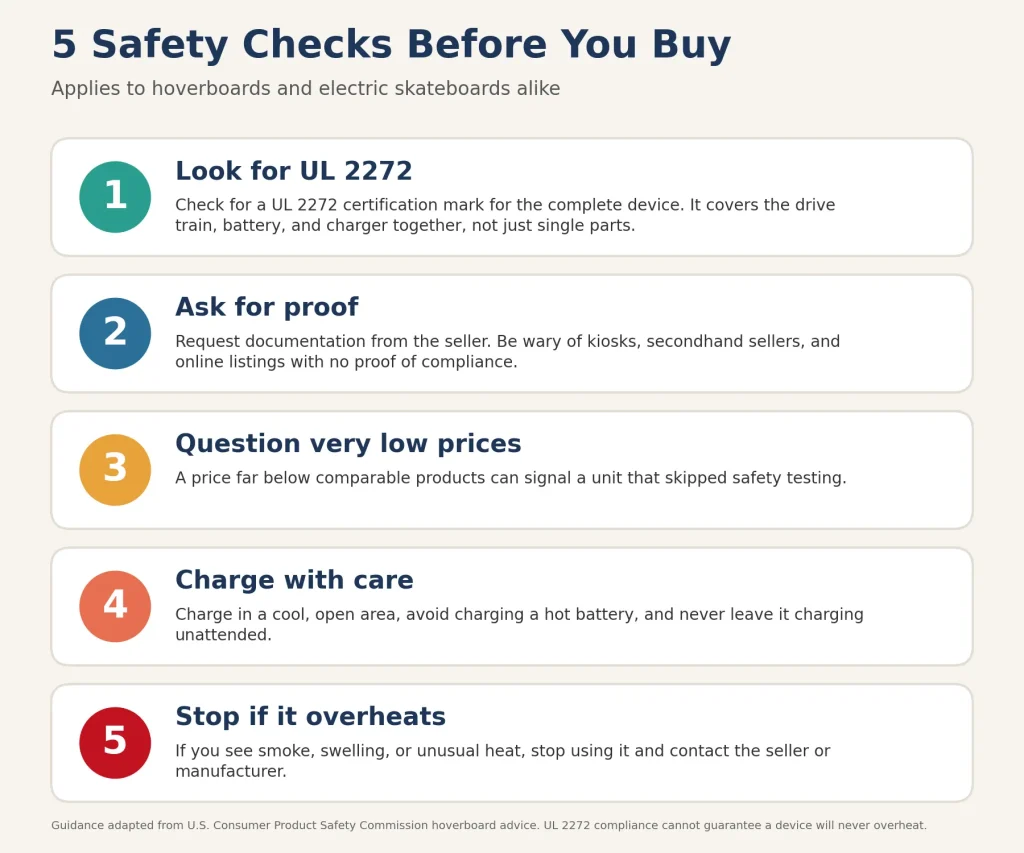
The standard at the center of this is UL 2272. It tests the complete electrical system of a personal e-mobility device, including the drive train, battery, and charger, and now covers a broad family of devices, not only hoverboards. UL explains its approach in its overview of e-mobility device safety. Two points from CPSC’s hoverboard safety alert are worth remembering. First, UL 2272 compliance cannot guarantee that a device will never overheat. Second, UL 2272 covers the whole unit, so a seller’s claim that individual parts are UL-listed is not the same thing.
Here is what that means for any shopper, whether you are buying a hoverboard or an electric skateboard:
Fire risk is only one side of safety. Falls are the other, and they are more likely at higher speeds, so a skateboard rider should treat a helmet, wrist guards, and pads as standard equipment. Review the safety precautions before your first ride, and if battery problems ever appear, our guide on what to do when your electric skateboard has a battery problem explains the warning signs. Heat is a major factor, which is why we advise never leaving your board in a hot car, and a regular maintenance routine helps catch problems early.
Laws and Where You Can Ride
Rules vary widely, and neither category is treated the same everywhere. In the United States, regulations differ by state and city, and there are different electric skateboard laws everywhere. Elsewhere, rules can be strict. In the UK, for example, government guidance on powered transporters names hoverboards among the devices that are illegal to use on public roads, pavements, and cycle lanes, though they may be used on private land with the owner’s permission. Always check local rules before you buy, and if you ride in shared spaces, always follow the basic electric skateboard etiquette that covers how to ride considerately.
Flying With Each
Air travel is limited for both. The FAA’s PackSafe guidance requires airline approval for lithium-ion batteries above 100 Wh and prohibits devices above 160 Wh in carry-on or checked baggage. Since most hoverboards sit near 158.4 Wh, they may be carried if the airline approves, but the FAA warns that many airlines do not accept them at all. Most electric skateboards have larger batteries that exceed 160 Wh, which makes them prohibited. The M24 2WD’s 806.4 Wh battery is far above the limit. Our guide to flying with an electric skateboard explains how to plan around this.
Cost
Hoverboards generally cost less. Electric skateboards typically range from about $600 to $3,000, with extremes below $300 and up to $5,000, as detailed in our pricing guide. A higher price on a skateboard buys more power, range, suspension, and build quality, while a very low price on either product is a reason to ask more questions about safety testing.
Which Should You Choose?
An electric skateboard is the better choice if you:
- Want to commute, ride trails, or climb hills
- Need more range and speed than a hoverboard can offer
- Are a teen or adult looking for a serious, long-term vehicle
- Weigh more than typical hoverboard limits
- Are willing to practice and wear full protective gear
A hoverboard may be the better choice if you:
- Want a simple, low-speed ride for short, flat distances
- Need the easiest possible first balance experience
- Are buying for a younger rider and will confirm the age guidance, safety certification, and supervision
- Prefer something compact and inexpensive
If you are thinking about a younger rider and an electric skateboard, don’t forget to read the best age to start electric skateboarding, which walks through the key considerations.
If you are weighing other kinds of personal electric vehicles too, we also compare skateboards with electric scooters, the Onewheel, and electric unicycles.
Ready to Choose?
If an electric skateboard sounds like the right fit, the Find Your Perfect Board tool matches boards to your riding style, and the Compare All Boards page puts specs side by side. For everyday street riding, check out our electric longboard and street series, as well as the compact Supermini. For trails and hills, explore the M24 2WD and the rest of our electric skateboard lineup. Our FAQ answers common questions, and the Ecomobl team is happy to help if you are unsure.
This article provides general information. Hoverboard figures are typical values from manufacturer guides and vary by model, and electric skateboard figures come from Ecomobl product pages. Always follow your product’s manual and your local laws.

